
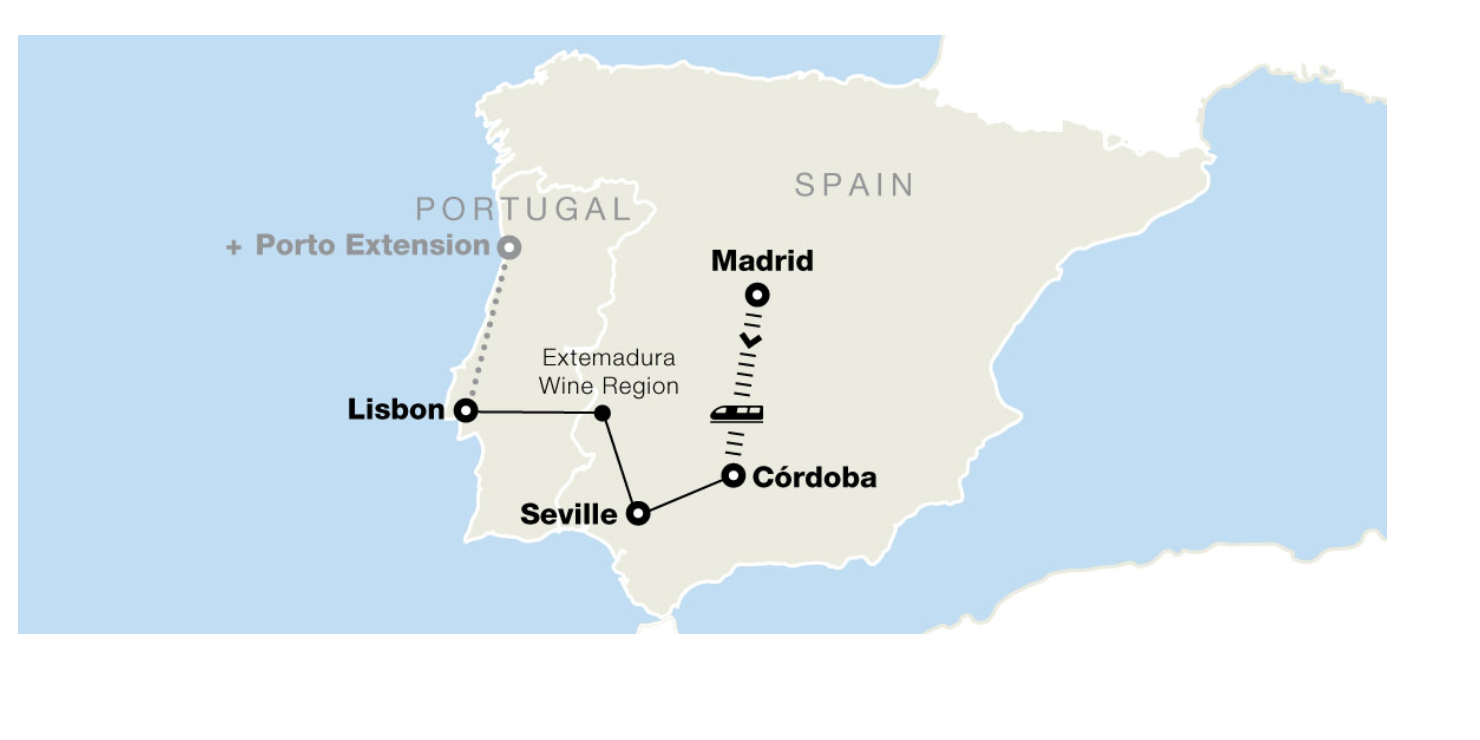
I am excited about this trip! This will be the first time I have traveled on an adventure with ALL women. It is going to be amazing to share the sights, sounds, and flavors of Spain and Portugal with my “sisters”.
I have visited other parts of Spain (Check out the blog page “Spain, France, Italy 2019”) and Portugal (Check out the blog page “Portugal 2023”). But I had not been to Madrid, Spain, where the tour begins. I also have not been to Porto, Portugal, where the tour ends.
Madrid is the largest city in Spain and the capital. It is a modern city with a historical atmosphere. Madrid is known for its museums, art, parks, cuisine, and sports. Porto, Portugal, was the birthplace of Port wine. It is also known for the Ribeira neighborhood, a UNESCO World Heritage site, characterized by narrow cobblestone medieval streets and colorful 18th-century structures.
Itinerary
Madrid
- Temple of Debod
- Royal Palace – Spain’s largest royal residence, built in Neoclassical style
- Plaza de los Guardias de Corps – Clara Campoamor sculpture, the mother of the Spanish feminist movement
- Liria Palace – the private residence of the Dukes of Alba and an art museum
- Madrid Flamenco Show
Toledo
- UNESCO World Heritage Site
- The “city of three cultures” – Christians, Jews, and Muslims peacefully coexisted during the Middle Ages
- known for swordsmithing
Cordoba
- high-speed train to Cordoba
- once a Roman outpost and an Islamic center during the Middle Ages
- Roman Bridge across the Guadalquivir River built in the first century B.C.
- Medieval Albolafia – historic watermill possibly from the ninth century
- Sreets of Old Town, reaching Cordoba’s Jewish Quarter with ancient synagogues next to Andalusian architecture
- Mezquita-Catedral de Córdoba, built in the 8th century as a mosque, was converted to a cathedral during the Reconquista (from the 8th century to 1492) when Christians retook the Iberian Peninsula from Muslim rule – UNESCO World Heritage Site
Seville
- Tour an olive oil hacienda in the Andalusia region
- Seville is the capital of Andalusia, with historic churches and Moorish architecture
- Plaza de España – a semi-circular structure built during the Renaissance and neo-Moorish styles for the 1929 Ibero-American Exhibition
- Murillo Gardens – filled with orange trees
- Barrio de Anta Cruz – neighborhood known for cobblestone streets, narrow alleys, and tiled benches
- Seville Cathedral – one of the largest Gothic churches in the world, 16th-century architecture and artwork by Goya and Murillo
- Royal Alcazar, once home to King Ferdinand II and Queen Isabella I
- Bodega Coloma in the Extremadura region, tour a family-owned, women-run winery
- Badajoz – a fortress city with Roman and Moorish roots
Lisbon
- capital city, largest city in Portugal
- City tour:
- Eduardo VII Park
- Praca Margues de Pombal – plaza commemorating Lisbon’s reconstruction after the earthquake of 1755
- The Monument to the Discoveries and Belem Tower
- A Avo Veio Trabalha, “Grandma Came to Work”, brings older Lisoetas together to make art and socialize, weaving demonstration
- Cook Academy – pastel de nata, iconin custard tart
Sintra
- the playground of Portuguese royalty
Coimbra
- The city of knowledge, home to one of the oldest universities in the world, the University of Coimbra
- The first capital of Lisbon was from 1139 to 1256
- Joanina Library housing 16th-century tomes and literary treasures
- monuments telling the story of Roman and Moorish occupation
Porto
- Plethora of Port wine cellars
- Azulejos adorning church facades, train stations,
- City tour:
- Liberty Square with Neoclassical buildings
- Carmelitas Church
- Doura riverfront
- Neoclassical Stock Exchange Palace – 60 years to complete interior, creating a combination of Neo-Palladian, Moorish revival, and other styles
- Douro River Cruise & Port Wine Cellar visit
Guimaraes
- UNESCO city, “cradle of Portuguese nationality”
- Political and military movements in 1128 lead to the formation of Portugal
- Palace of Dukes of Braganze
- Largo da Oliveira square
- Baroque style church
- Vinho Verde, local wine
 Roaming the World with Mrs. Kelly