
This Germany trip will be as a group leader of 15 high school students. We have spent two years planning and preparing for our trip. The students will visit a variety of cultural and historical sites, as well as a school visit. The trip focuses on exploring Germany through the lenses of Berlin and Munich.
Departure – June 19
We began our journey by departing by car, van, and truck from Scales Mound School. Parents delivered us to the bus station in Rockford, Illinois, where we purchased round-trip tickets to O’Hare. This is a great way to learn about one option to travel to the airport.
Day One
We arrived at the international terminal of O’Hare airport, all students checked in like professional travelers and moved through security quickly. This gave us time for our first exploration of the trip. Many students have not been to O’Hare airport. So having a little extra time to find our departure gate and then wander the airport to find lunch before boarding for a 7-hour flight to Amsterdam.


Day Two
After a long flight from Chicago, we arrived in Amsterdam for a short layover before departing for Berlin. Students had a little time to freshen up and explore the airport, finding some interesting foods for breakfast and of course, coffee. Then off to Berlin to meet our partner travelers and tour director, Anje.


On our first day, we toured Berlin, learned how to use the subway, went to a Turkish restaurant for dinner, explored a local grocery store, and then slept very soundly.
Day Three
Our first full day started with a city tour of Berlin by bus with stops at Unter den Linden, Brandenburg Gate, the Reichstag, and Alexander Platz. A tour of the Topography of Terror Museum that displayed the rise of the Nazi part, the persecution of the Jews, and how citizens were at risk if they did not cooperate. The museum opened in 2010 and is the site of headquarters of the Secret State Police (Gestapo), the Reich SS leadership and security (SD) of SS and in 1939 the Reich Security Main Office. The original buildings were greatly damaged in the final days of World War II. Original sections of the Berlin wall were visible outside the museum. Today the Topography of Terror Foundation provides historical information about Nazi terror.
We stopped for lunch and exploration in the area of Checkpoint Charlie. Travelers could take their picture with “soldiers” at Checkpoint Charlie, do a little shopping, tour a 360-degree picture exhibit of the Berlin wall that included sunrise to sunset and the sounds heard from the wall. Students also had the opportunity to leave a message of peace on the wall or floor of the exhibit. I also visited a Tabby tourist shop and got to sit in a Tabby, the only car that could be purchased in East Germany. It was a Russian car and took up to 15 years to get one after completing an application.
Our next adventure was a city tour by a double-decker bus. Traveling down Unter den Linden from the city palace to Brandenburg Gate learning about the rich history of the city of Berlin. Travelers experienced walking through the Memorial for Murdered Jews of Europe. We viewed the outside of the Reichstag and the Memorial to the Murdered Members of the Reichstag. We walked through a Jewish neighborhood on our way to dinner, walking past the oldest Jewish synagogue in Berlin, a Jewish cemetery, and the plates on the sidewalk indicating a former home of a Jewish family was pointed out. We finished our tour by visiting the Third Street Gallary, always a great experience when in Berlin.
We ended a busy day listening to a discussion of three panelists who talked about living on both sides of the Berlin Wall. It was amazing the lady that grew up on East Germany didn’t feel like she missed anything growing up. Travelers were exhausted from our day, yet still stayed focused and were amazed at the three ladies stories.
Day Four
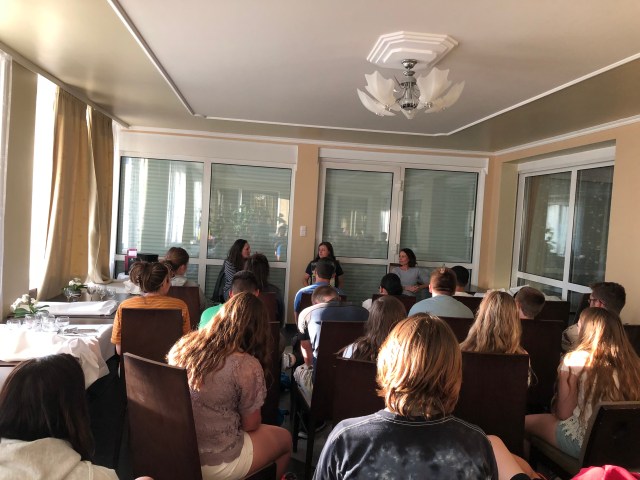
Today we start our day learning about schools in Berlin. We visited a local high school and the students had the opportunity to talk with students. It was the last day of school before summer break. Seniors were allowed to “trash” the school as their senior prank. They wrote messages on windows, threw their papers all over the hallways, squirted the underclassman with water guns, and then cleaned the school. The teachers got a tour of the school and classrooms. Science and math classrooms were high-tech, language classrooms not so much. The reason…Science and math are deemed as more important. Somethings are the same no matter where you teach.
Both groups of students did not want the visit to end. What a great experience for the students to find out they are from different countries but still just teenagers with teenage views.
Lunch was in a plaza near Brandenburg Gate. Some travelers road a Ferris wheel, whiles others selected to shop and explore. During the afternoon we toured the Reichstag building dome where we had a panoramic view of the city of Berlin. After dinner, we toured the underground bunkers used during World War II after dinner. We also had a special guest join us for dinner. Christa, an exchange student at SMHS during the 1982-83 school year, traveled from Hamburg to visit with me and three students. The students’ grandparents were Christa’s host parents and their moms were her host sisters. It was wonderful to chat about her year visiting SM. The best part was the students were meeting her for the first time. Such a special visit for all five of us.
Day Five
Today was a travel day. We are riding on a bus for seven hours to Munich for the second half of our experience Germany adventure. We stopped a few times at truck stops for short breaks and lunch. Always an interesting experience to see the similarities and differences in how people travel to other countries. It was also some really nice quiet time to sleep and listen to music after busy days in Berlin.
We stopped at Modlareuth, also known as mini-Berlin, a village of 50 people. It was divided by a stream during at the end of World War II and split the village between East Germany territory controlled by the Soviet Union and the Bavarian part belonged to West Germany, initially the American occupied zone. In 1952 a wooden wall was built to divide the village. In 1966 a 700-meter concrete wall was built and divided the village for 23 years. We watched a film about living with a divided community, saw an exhibit of 30 vehicles used to patrol the wall, and climbed up into a guard tower. This visit really brought the extent of the Cold War to light for the travelers.


We identified crops during our travels to Munich. Nice to add an agriculture component to our trip.


I have not talked much about food. German breakfasts at the hotel are the best! Cheese, meat, eggs, bread, jam, yogurt, apple juice, and strong coffee. Who could ask for anything more?

Day Six
Our day started with a bus tour of Munchen (German spelling of Munich). We toured the grounds of Nymphenburg Palace. The palace was built in 1664 by Elector Ferdinand Maria of Bavaria for his wife Henriette Adelaide of Savoy because she gave birth to the heir to the throne, Max Emanual. It was the summer residence for rules from the Wittelsbach dynasty. The palace was added to many times and representing the Baroque, Rococo, and Neoclassical styles of architecture. King Ludwig II of Bavaria was born in the palace. I managed to slip into the staple, Marstallmuseum to check out some carriages spanning from three centuries. We visited Marienplatz for lunch and to see the Glockenspiel. The carved figures tell the story of a royal marriage including knights jousting and dancers. A once in a lifetime experience.
The afternoon tour was of Dachau Concentration Camp and Memorial. We watched a video about the history of the camp, toured the museum, viewed the memorials by many different religions, and walked the barracks, including seeing the crematory and showers designed to gas groups of people. (The showers were never used for some reason.) It was a somber, intense, eye-opening visit. Having visited the Illinois Holocaust Museum in Skokie at the end of the school year, students commented how now actually seeing a camp helped them to understand the images they saw at the Skokie museum.
Dachau concentration camp was build in 1933 for political prisoners. It was a prototype for other camps and was the “school of violence” for the SS. The camp was in operation for 12 years and over 200,000 people in Dachau and its 140 subcamps. American troops liberated the camp in 1945. Between 1945 and 1948 the U.S. military imprisoned National Socialist officials and members of the SS. The camp was then used to house refugees until 1963/64. The Dachau Concentration Camp Memorial Site was established in 1964. It is a cemetery, museum, memorial site, and place to learn about the history of the camp system.
Day Seven
Today’s itinerary included a tour of the BMW Group Plant Munich, time to sit in a few dream cars, and a walk to the Olympiapark. The BMW Plant is the world headquarters for the company, employing 7,700 people from 50 countries. Each day 950 cars and 3,000 engines are manufactured using robotic technology. The plant began in 1922 building aircraft engines, then motorcycles, now cars and engines. During our tour, we observed production in the press shop, body shop, paint shop, engine shop, the production of interior equipment and seats, and assembly.
The Olympiapark in Munich is the site of the 1972 Summer Olympics games. The buildings are designed with aluminum tent-like structures to create the effect of the Alpine mountains that Bavaria is known for. The Olympic village was the location of, what is known today, the Munich massacre where 11 Israeli team members and a West German police officer were murdered by Black September Palestinian terrorists during the second week of the games. The Israeli team returned to their country, even though the games continued out of respect for the athletes and to show the spirit of the games will go on. Today the park is used for football games (soccer), concerts, cultural events, sporting events, and extensive walking paths.
During the afternoon we returned to Marienplatz for lunch and to spend time shopping, wandering through the open-air farmers market, and just hanging out people watching. Travelers found traditional German souvenirs, such as beer steins, and the original, made in Germany, Birkenstocks.
Day Eight
This morning we departed early for a two-hour drive to Neuschwanstein Castles, (translated as the New Swan Stone Castle) built on a “rugged hill” above the village of Hohenschwangau. The castle was built by King Ludwig II of Bavaria using his personal fortune, not the money from the people of Bavaria, in the Romanesque, Gothic, and Byzantine styles. It was commissioned in 1886.
Ludwig II became king at 18 years old and was only in power two years before the Austro-Prussian War where Austria and Bavaria were conquered by the Prussians and King Ludwig II lost his power. He was considered to be eccentric and reclusive. He died mysteriously near Lake Starnberg with Dr. Bernhard von Gudden.
Neuschwanstein Castle was the inspiration for the Walt Disney castles in both classic Cinderella movie and Snow White’s castle in Disneyland.
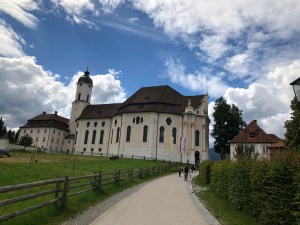
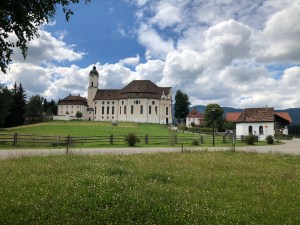
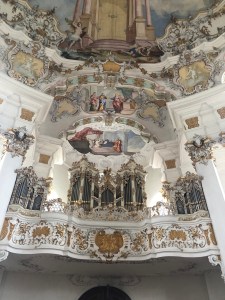
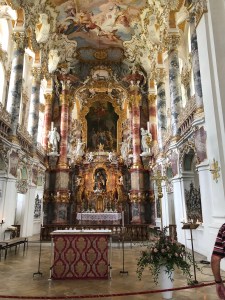
While traveling to see Neuschwanstein Castle, we stopped at the Wies Pilgrimage Church of the “Scouraged Saviour” built in the 1740s. In 1730 Father Magnus Straub and Friar Lukas Schweiger of the Premonstratensian monastery of Steingaden built a figure of the Scourged Savior to be used for the Good Friday procession. The statue was put away because the congregation was upset by the amount of blood and wounds on the piece. The statue was moved to the “Wieshof” in 1738. During evening prayers on June 14, 1738, the “Miracle of the Wies” took place. It was noticed that drops of blood appeared on the face of the “Scouraged Saviour”. This began the pilgrimage movement to the “Wies”. The chapel was built to accommodate the many pilgrims coming to see the savior. Today over one million visitors from all over the world come to see the “Scouraged Saviour” Jesus Christ, Son of God, who sacrificed his life for all mankind and to worship at the “Wies”. The Wies Church is now listed as a Cultural Heritage Building by UNESCO.




 Roaming the World with Mrs. Kelly