
Hello world!
I will be traveling to Singapore in June, 2015. This is a very special trip as I will be traveling with my sister, Janet, to see her son, Curt, daughter-in-law, Jenn, and granddaughter, Bailee. Why are we going to Singapore to see family?….Jenn and Curt selected Singapore for Jenn’s Naval deployment. They have been living there since January 2014 and we have not seen them since Christmas 2013.
The count down has begun!
Two weeks from today will be my first day in Singapore. I fly from Chicago O’Hare airport on June 16 at 12:30 p.m. I will arrive in Narita International Airport in Tokyo, Japan, at 3:10 p.m. on June 17. Then off to Singapore leaving at 5:55 p.m. from Narita to arrive Changi International Airport at 12:05 a.m. on June 18.
I am excited for a short layover in Japan. I loved my trip to Japan and will enjoy even a few minutes to soak up the atmosphere at Narita (and to look out the window).
A Little History
Singapore consists of a main island and 60 small islets, located at the southern end of the Malay Peninsula. It is one of the busiest port cities in the world due to it location on the Strait of Malacca which connects the Indian Ocean to the South China Sea.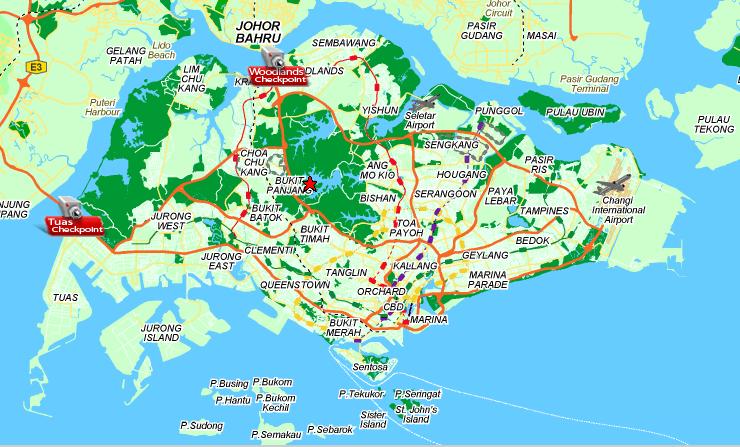
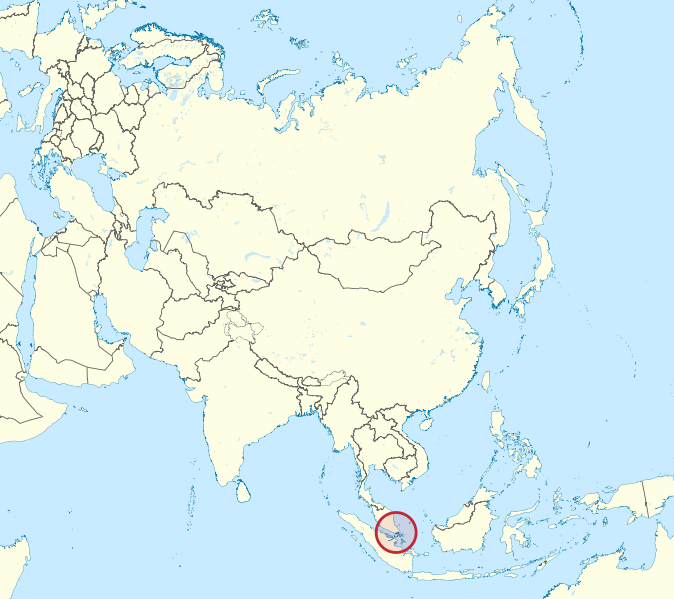
Inhabited by fisherman and pirates. Chinese traders as far back as CE 300, on their way to India, traveled the Strait of Malacca and referred to an island as Pu Luo Chung, which may have been Singapore. In the CE 1200s a Sumatran Srivijayan prince settled on the island and named it Singapura (Lion City) because he saw a lion there.
The Portuguese attacked in CE 1613 and burned the town to the ground. In CE 1819 Sir Stamford Raffles signs a treaty with the Sultan to give most of the control of the island to the British for a port. In 1826 traders seek free ports in Singapore to avoid Dutch tariffs at other ports in the area. Singapore remained under the control of the British until Japanese invasion in 1942. It is renamed Syonan by the Japanese. The Japanese massacres many Chinese. The British resume control in 1945 with the surrender of the Japanese military.
Full legislative elections are held in 1959. People’s Action Party (PAP), led by Lee Kuan Yew, wins resulting in economic and social programs being launched. In 1963 Lee Kuan Yew leads Singapore to join Sabah and Sarawak to combine with Malaya to form the single state of Malaysia.
The Republic of Singapore in created in 1965 after it was expelled from the federation due to race rioting between the Malays and the Chinese. The British forces withdraw from the republic in 1971. By 1975 Singapore becomes the world’s third largest port and third largest oil refiner.
Fast facts!
- One main island and 63 tiny islands (most uninhabited)
- Total land area 682 square kilometers (USA is 15,000 times bigger at 9.842 million square kilometers)
- Originally known as Temasek, meaning “sea town” in Javanese
- Sang Nila Utama, a Srivijayan Prince named Singapore Singapura, meaning “Lion City” in Sanskrit, in 1299 but there were never lions in Singapore. It is believed he probably saw a tiger.
- There are only three sovereign city-states in the world: Singapore, Monaco, and Vatican City.
- Second densest sovereign state (6,430 people per square kilometer) in the world, after Monaco (United States has 35 people per square kilometer)
- Sixth wealthiest country
- 20th smallest country
- Singapore has four official languages: English, Chinese (Mandarin), Malay, and Tamil.
- Singlish (mixing English and Chinese, Malay, and Tamil phrases is widely spoken Singaporean patois
- 17 reservoirs and 4 nature reserves with 1.3 million trees, nicknamed “City in a Garden”
- Highest point is Bukit Timah Hill (164m above sea level) and contains more species of trees then the entire North America (Charles Mound 376m [1235ft]
- Singapore Zoo home of the world’s first night zoo, highest man-made waterfall located in Jurong Bird Park, and Singapore Flyer the world’s largest observation wheel
- The flying fox, world’s largest bat with a wingspan of 1.5 meters is found on the island of Pulau Ubin
- Largest exporter of ornamental fish (25% of world market)

- Merlion Park has the largest cast bronze fountain in the world located in Suntec City – cost US$6 million to build in 1997
- 8 out of 10 people own cell phones
- Low crime rate – rated second in personal safety behind Luxembourg
- Mandatory death penalty for drug possession
- Chewing gum has been banned since 1992 a medical prescription is required to be allowed to chew gum, reason – gum was disposed of on train doors and caused disruption of train running of time
- Highest density of McDonald’s restaurants in the world
- Males are required to serve in the National Service (military) for 2 ½ years when turning 18
- Highest rate of lightning activity in the world (average of 171 thunderstorm days per year)
Works Cited
1) “10 Fun Facts about Singapore.” MyDestination.com Singapore Travel.
N.p.n.d. Web. 19 June 2015.
2) “41 Interesting Facts about Singapore You Never Knew – Amazing and
Weird.”Amazing and Weird. N.p., 26 Apr. 2014. Web. 19 June 2015.
3) “Amazing Singapore – Intriguing Facts.” Amazing Singapore – Intriguing
Facts.N.p., n.d. Web. 19 June 2015.
4) “Singlish Guide.” – YourSingapore.com. N.p., n.d. Web. 19 June 2015.
Tracking the flight to Singapore
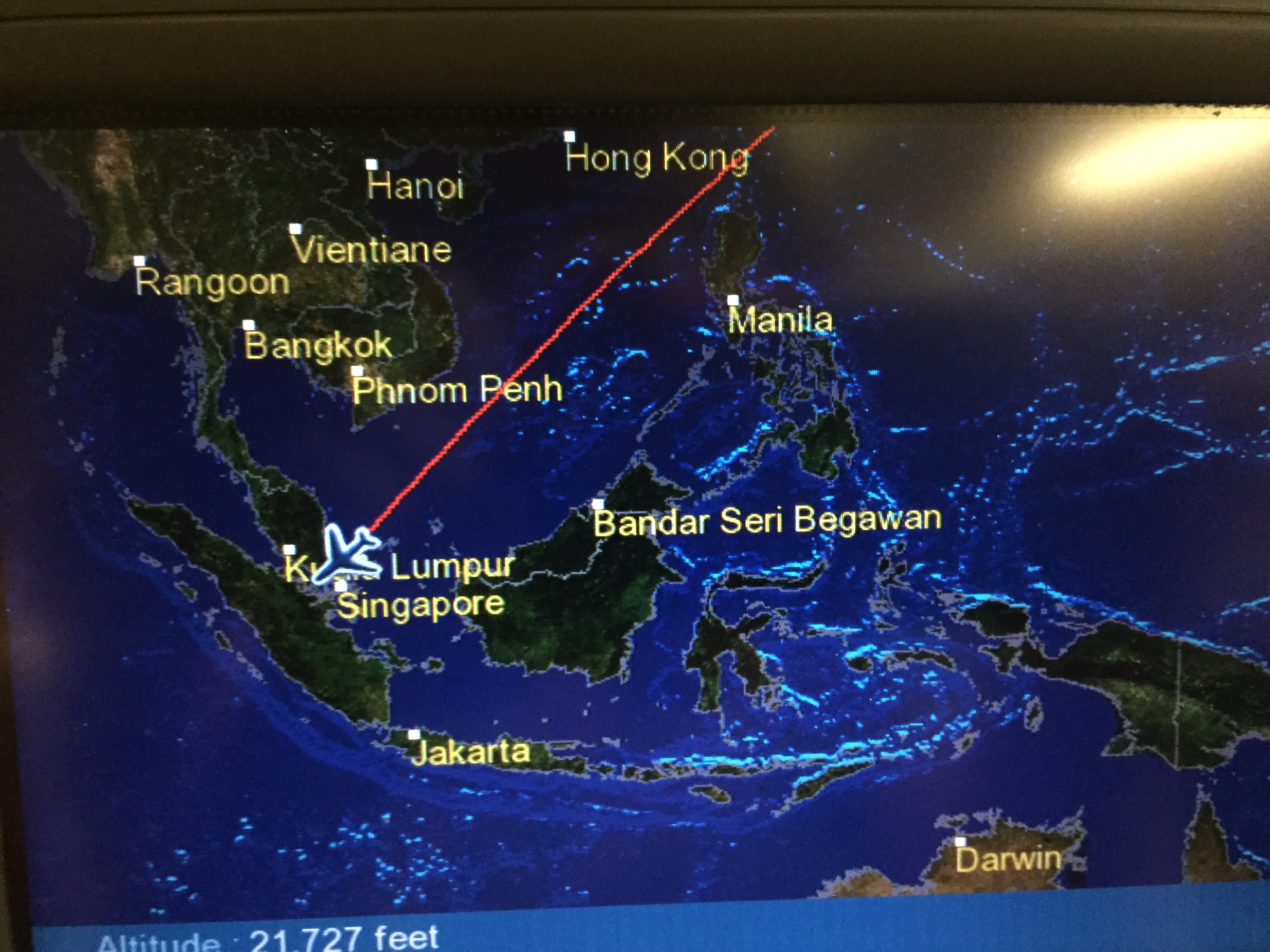
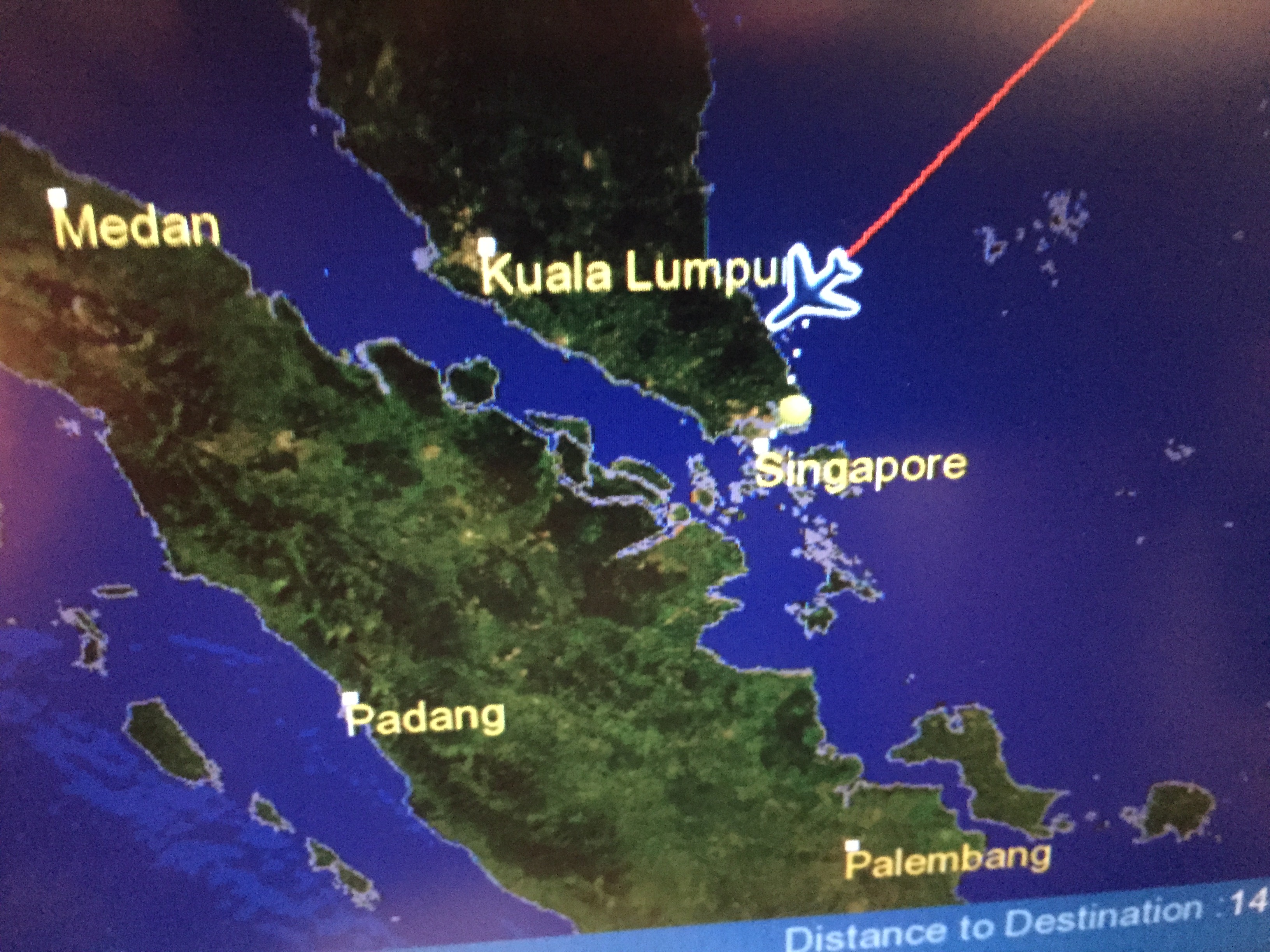
Tracking air travel is an interesting way to pass the time. Some flights offer TV screens on the back of the seat in front of you so it makes it very easy to take pictures of the flight map on the screen. It also offers each passenger to select the in flight movies they would like to watch.

A short stop in Tokyo!
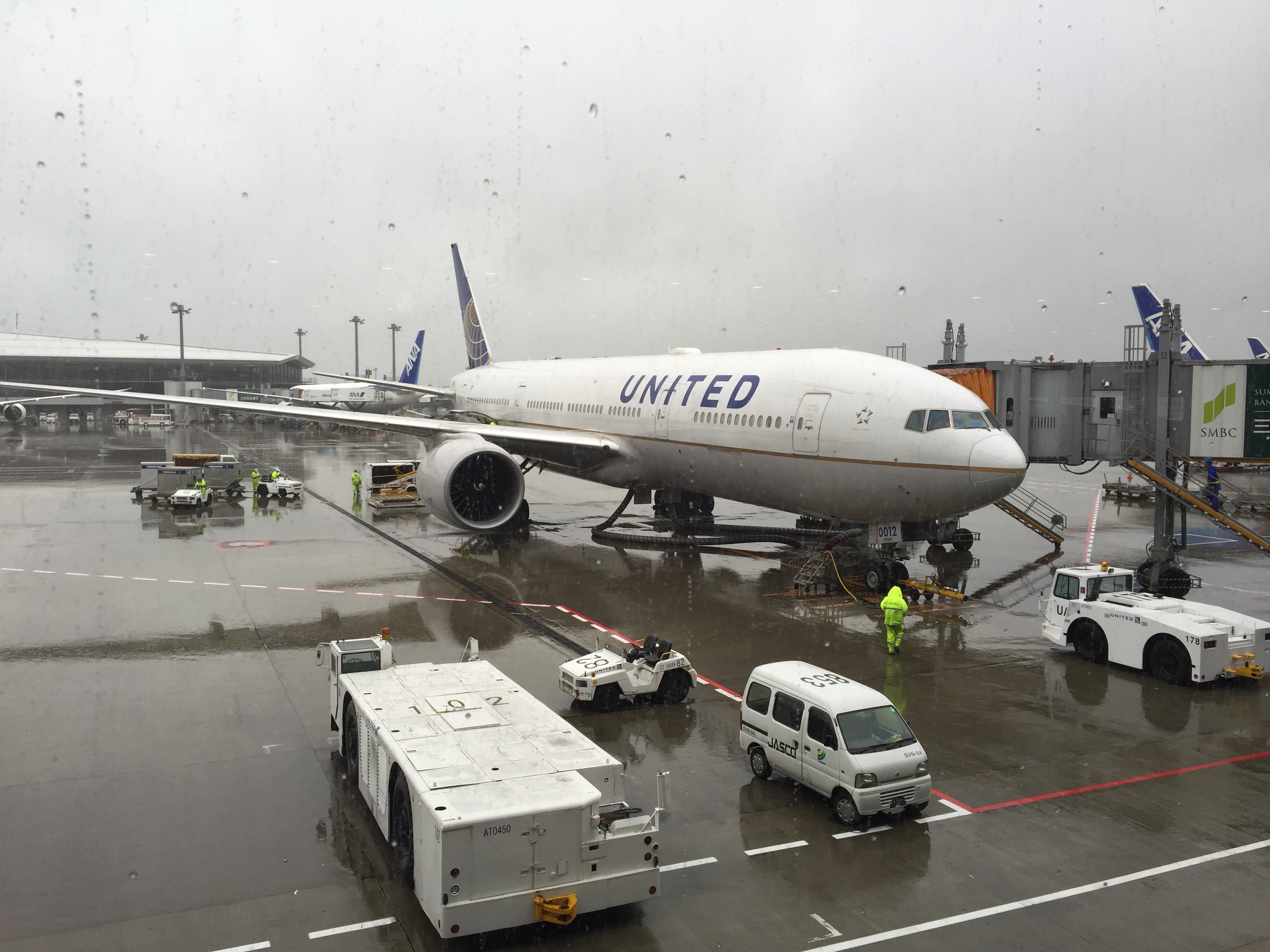
Often long airplane travel is broken up by stopping in another country. There are advantages and disadvantages to a “lay over”. Of course one of the obvious advantages is to be able to take a walk to stretch you legs. But another advantage is to experience another culture, even if it is only for a short period of time.
My flight itinerary include a short lay over at the Narita Airport in Narita, Japan, located outside of Tokyo. After the 14 hour flight from Chicago to Japan a little walk, some Japanese culture, and a bite to eat is always refreshing before back on the plane for the final 7 hour flight to Singapore.
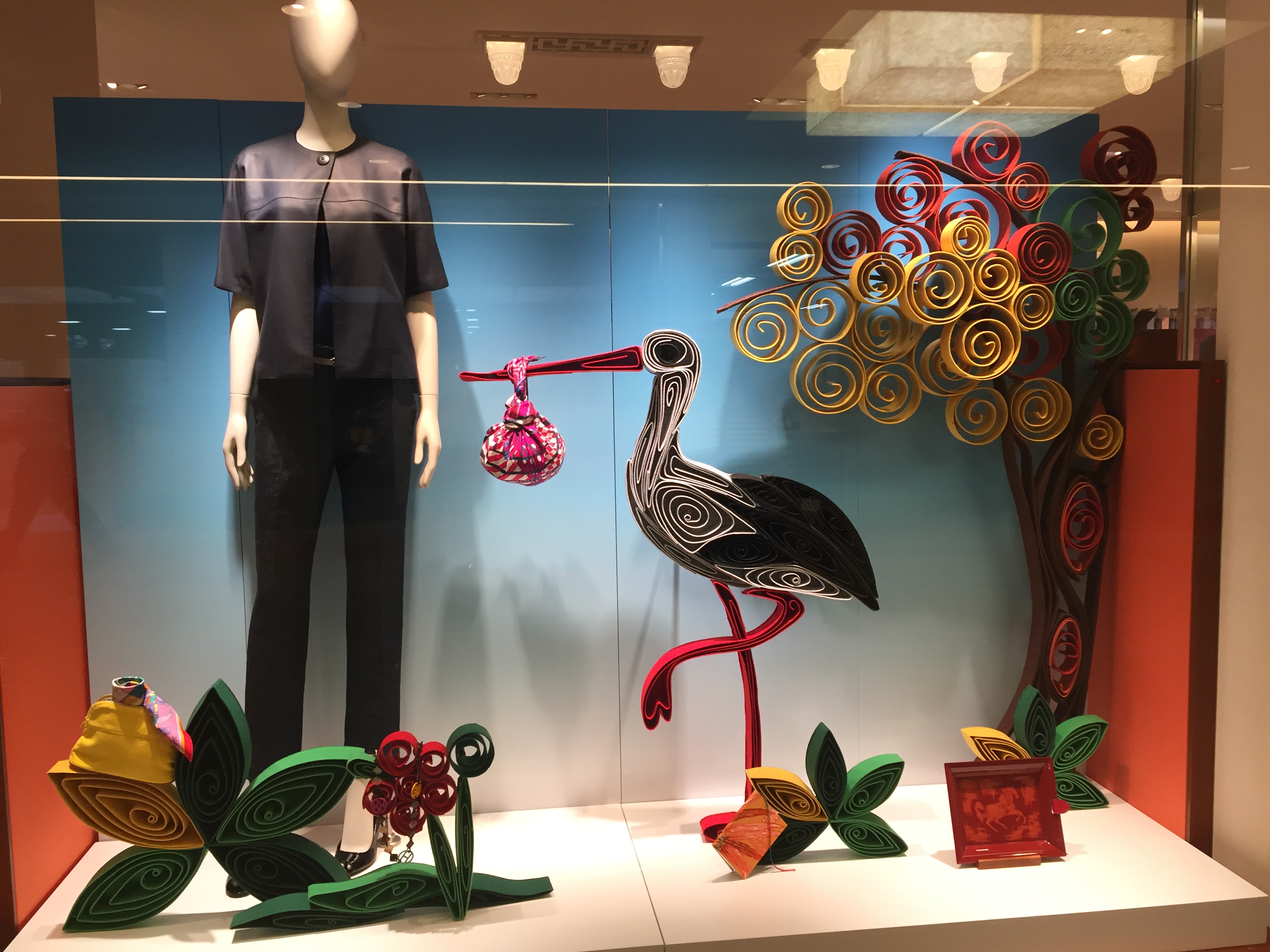
A display of origami and an outfit that can be purchased at the airport

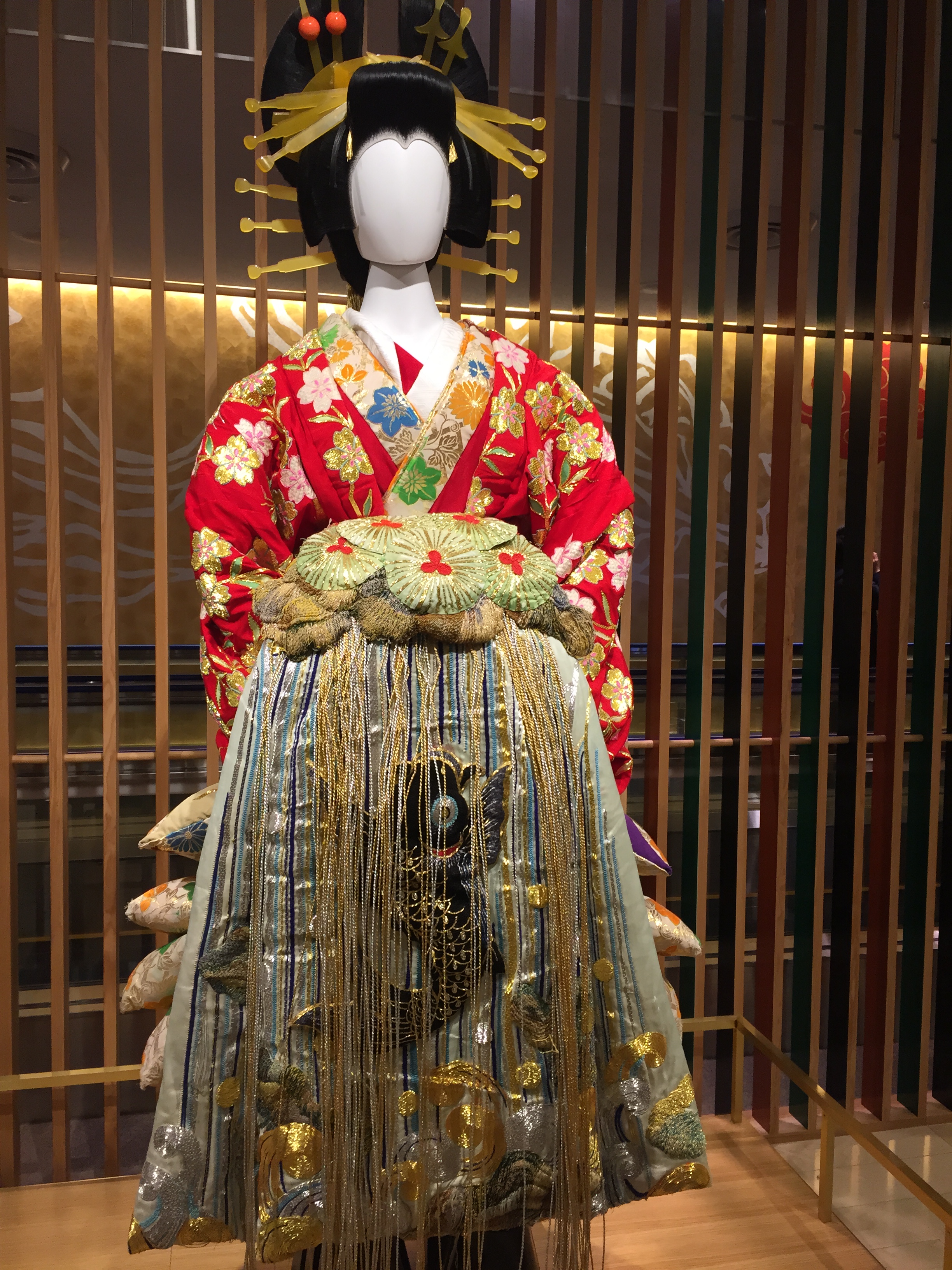
Traditional Japanese clothing on display in a boutique

Traditional Japanese wedding costumes

ET making some new friends
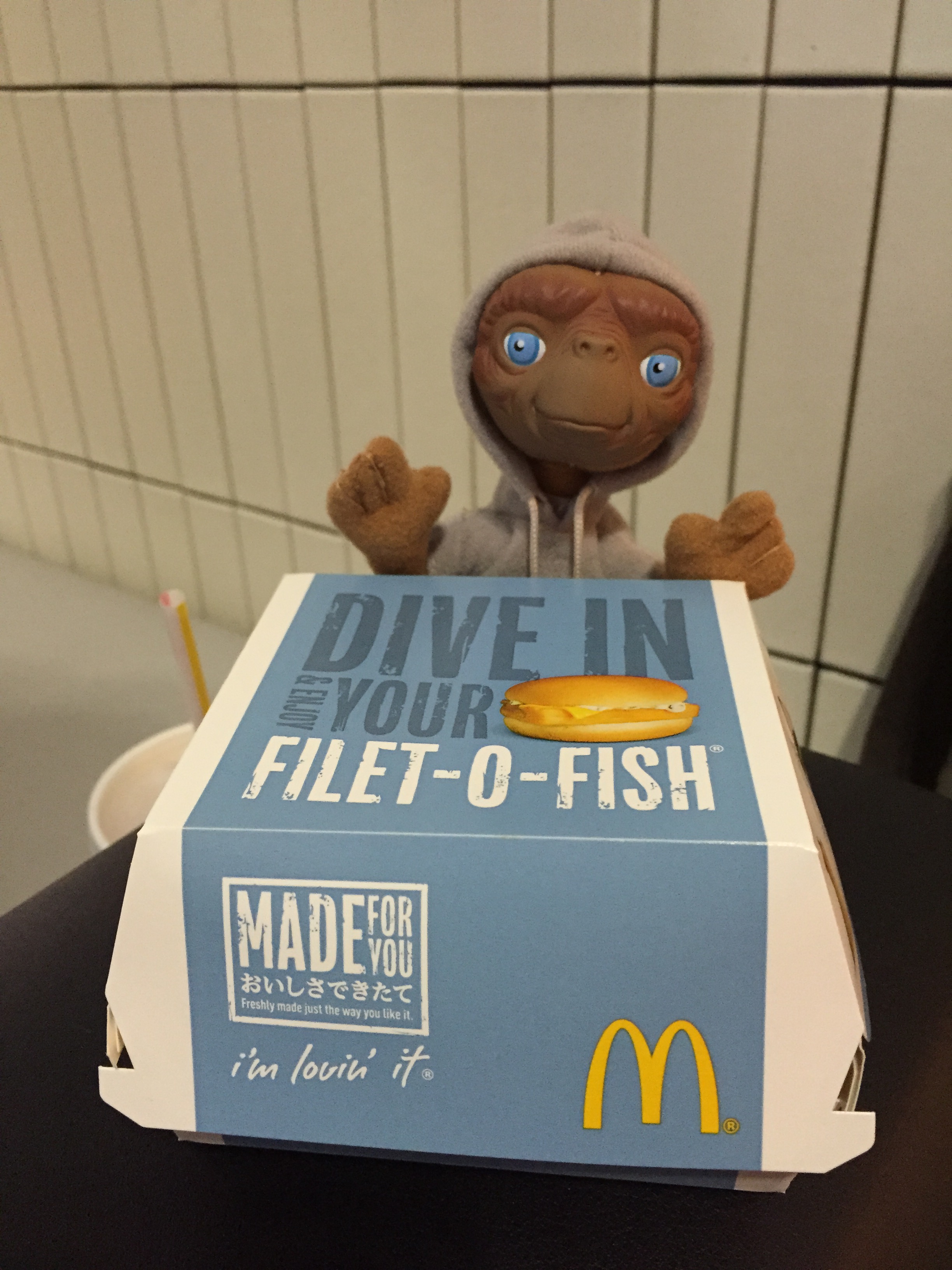
Time for a little lunch at McDonald’s

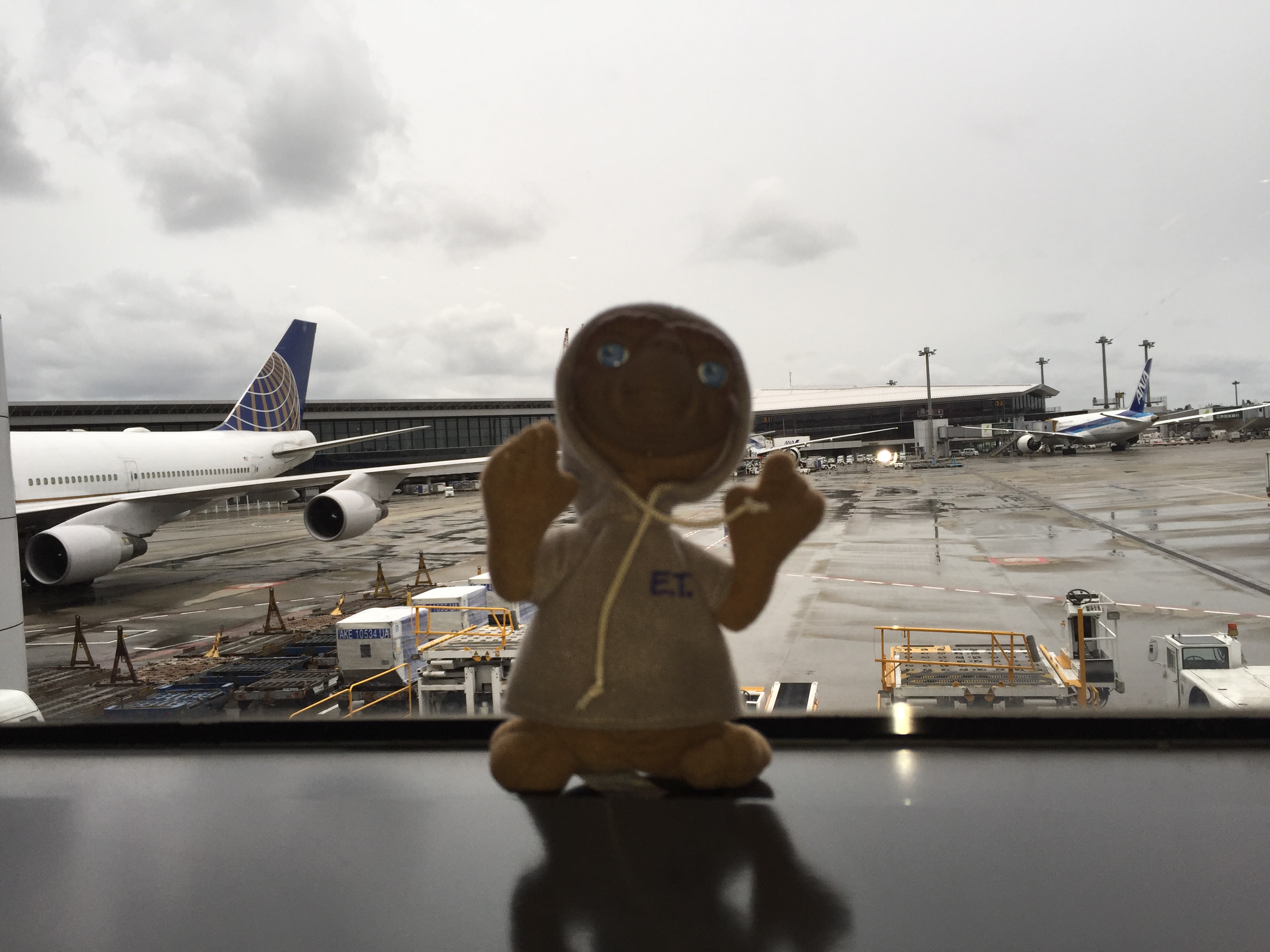
And then back on the plane for SINGAPORE!
“Speak Good English”
English, Malay, Chinese (Mandarin) and Tamil are the official languages. Singlish is a mix of English, Malay, Chinese languages such as Hokkien or Cantonese, and Indian languages of Tamil or Punjabi. Widely spoken by local Singaporeans. The government started a campaign called the “speak good English movement” in 1999 due to Prime Minister Goh Chok Tong calling Singlish “English corrupted by Singaporeans”.
- Lah – used at the end of a sentence to give emphasis “don’t like that lah”, “No, lah!”
- Bao Toh – to tattle
- Catch No Ball – don’t understand
- Chop-Chop – hurry up
- Lobo – originally a soldier without assignment, today a lazy person
- On the Ball – hardworking, enthusiastic
- Don’t pray pray ah! – “Don’t mess around!”
- Can can! – “Yes, definitely”
- Dohwan – “No, thanks” / “I don’t want it”
- Auntie/ Uncle – a respectful way to address an older man/woman
- Car park – parking garage
- Kopi – coffee with condensed milk
- Kopi-O – coffee and sugar
- Kopi-C – sugar and evaporated milk
- Kopi-O-beng-gao-siew-dai – thick iced coffee, no milk, hold the sugar
- Aircon – air conditioning
Singaporean phrases students would say:
“Eh why you go all for recess never jio me today?! Bo jio leh you guys?”
- What it means: not calling someone along to an event or activity
- Language: Hokkien
“Wah GG lah, I forgot that there’s a test today!”
- What it means: originated from gamers, “gg” originally means “good game”, used n a study context, it means that you are doomed (aka game over)
- Language: English
“Oi, chio bu (pretty girl), want to steady not!”
- What it means: a way of asking someone to be your girlfriend/boyfriend
- Language: English
“Oi! Why did you kope my social studies answers!”
- What it means: to take someone else’s things (usually without permission)
- Language: Singlish
Video examples:
Works Cited
1) “10 Singlish Slangs Every Student Would Have Used in School | Epigami
Blog.”Epigami Blog. N.p., 01 July 2014. Web. 20 June 2015.
2) “Singlish Also Can!” I Was an Expat Wife. N.p., 28 Mar. 2011. Web. 20 June
2015.
3) “Singlish Lesson 2 – “Repeated Words – Play Play Only Lah!”” YouTube.
YouTube, n.d. Web. 20 June 2015.
4) “You Singaporean?” YouTube. YouTube, n.d. Web. 20 June 2015.
How much money am I spending?
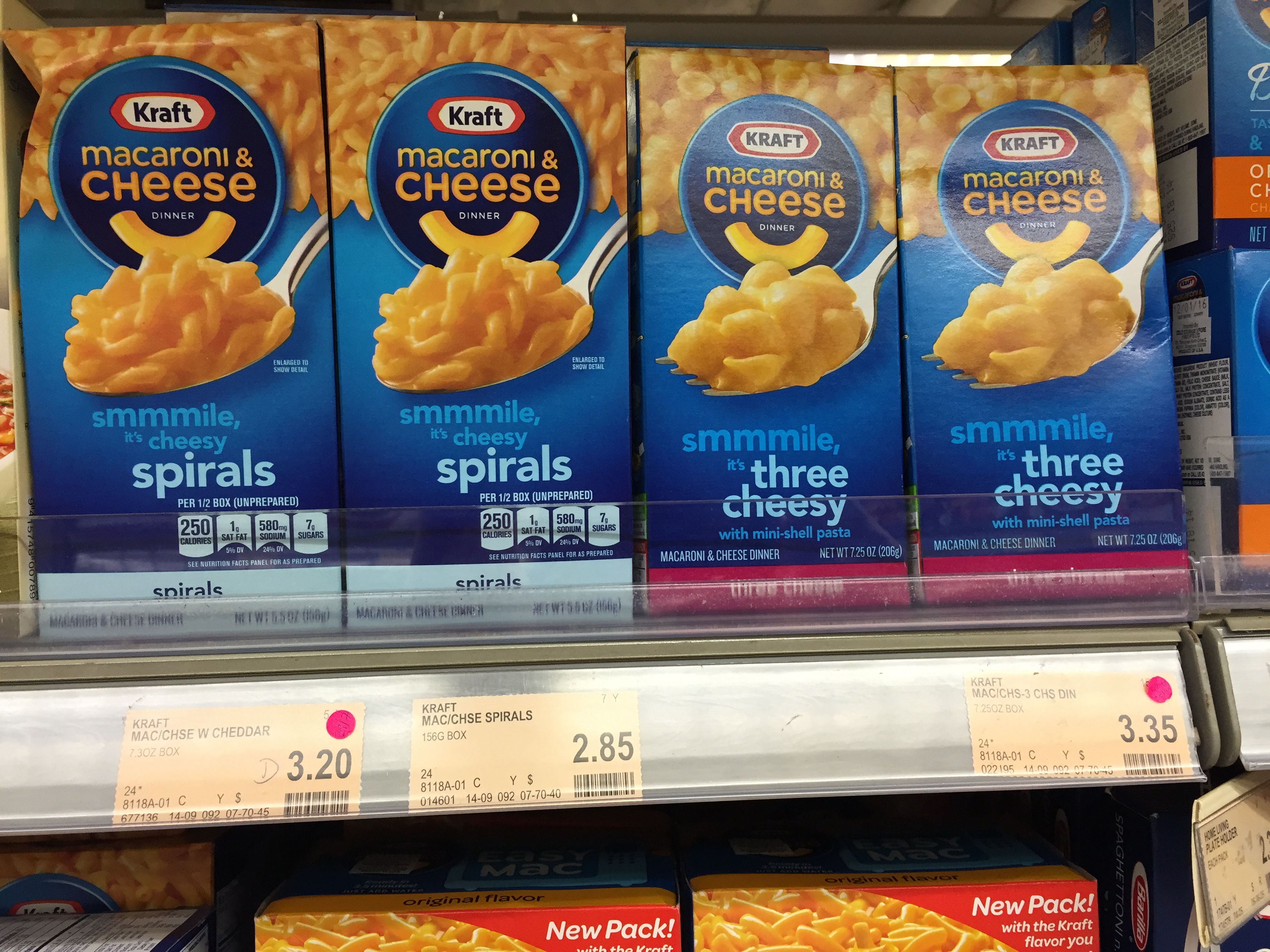
Purchasing food in another country is always a cultural adventure. A traveler can always find foods that are similar to those eaten in the states. Sometimes the labels will be in English other times they will not. A shopper can look at the pictures on the packaging to identify the product. And if you cannot identify the contents from the packaging you have just “jumped out of the box” to explore how the locals eat.
Check out the packages below. Do you recognize them? Yes, very American. Check out the prices.
Today’s currency exchange is US $1 to S$1.34.
How much would the Mac and Cheese cost in US$?
Regular Mac & Cheese – S$3.20 = US$
Spiral Mac & Cheese – S$2.85 = US$
Shell Mac & Cheese – S$3.35 = US$
How much would the Cool Ranch Doritos cost in US$?
S$4.25 = US$

A quick traveler conversion:
using the price of the item divide by 3, then times by 2
This is not an exact conversion but works well when shopping and you need to calculate quickly in your head.
Even Jared (Subway guy) could find food in Singapore
Visiting a Subway Restaurant in Singapore is the same dining experience as when you are in the United States, Japan, Germany, and maybe even Afghanistan (Explore our World – Subway). Singapore has 121 Subway Restaurants making it very easy to find an “American” sandwich when you need one.
It is always an interesting experience to eat at a popular American chain in another country. Sometime the selections are different, but many times they are very similar with some added selections to meet local cuisine. You will find the ordering process to be very similar. You select the bread, size, meat, cheese, veggies, and sauces. The sandwich can also be toasted in an oven that looks exactly like the one at your neighborhood Subway.
Can you figure out what we ordered for lunch?
How much did it cost in S$?
How much did it cost in US$?
How many “Sing” did I give the cashier? How many US$ would that be?
What was my change in S$? How many US$ would that be?
You can use a currency converter to convert the amount exactly according to today’s exchange rate or you can calculate to get a quick (close) estimate
S$ divided by 3 times by 2
Was it cheaper for us to eat in Singapore or would it be cheaper to purchase the same order in the United States?
Don’t Feed the Monkeys!
Long-tailed Macaque is a monkey species commonly found in Singapore. They are somewhat of a nuisance, much like the deer population in backyards of northwest Illinois. The big difference between the monkeys and deer is that deer will not attack you when threatened.
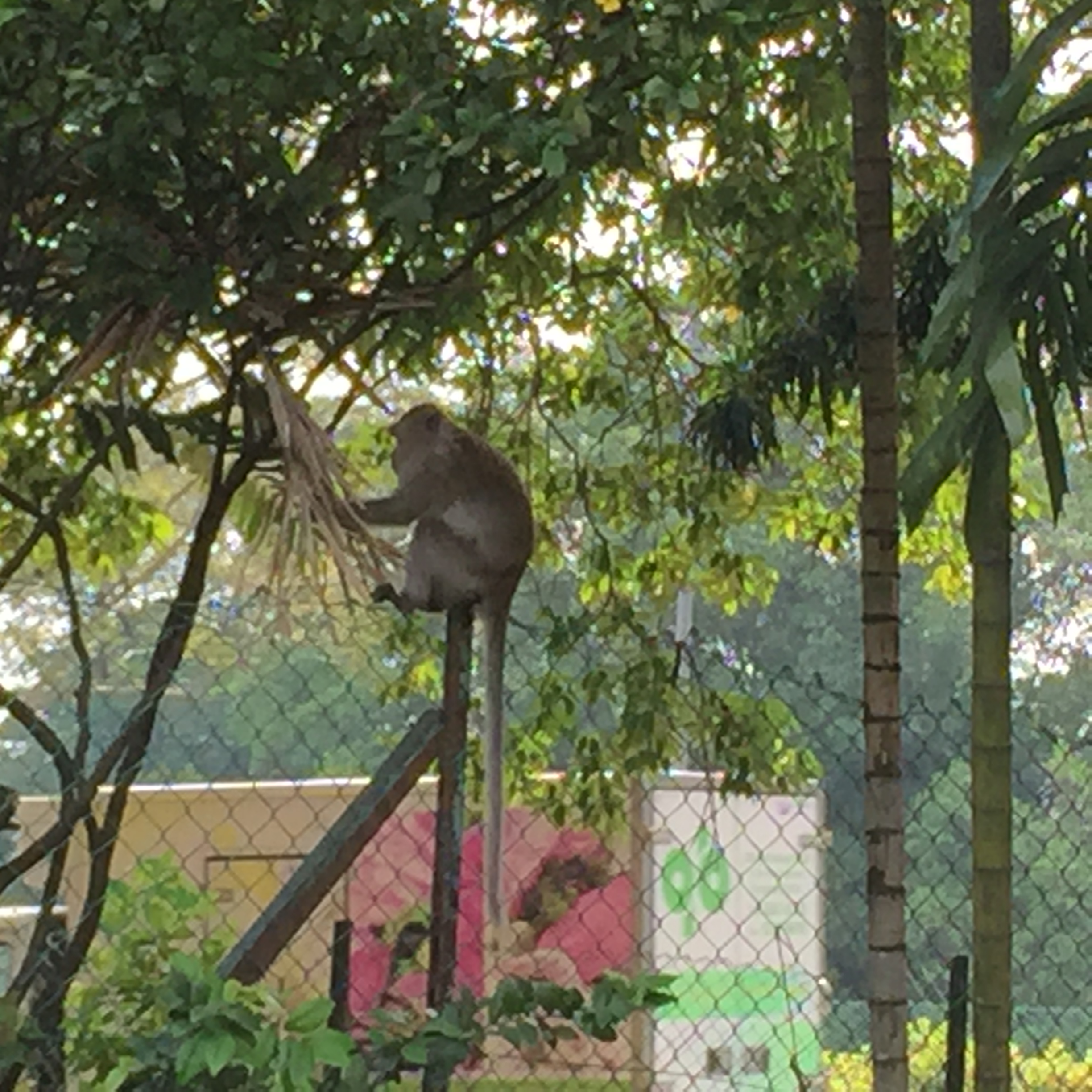
The monkeys live in or near the rainforest nature reserves and forested parks. The Singapore long-tailed macaque is different from the ones found in other Asian regions. They are smaller in size, have a larger tail to body ration and facial features are different. The monkey is very advanced in using stone “tools” when foraging for food. They are primarily omnivores, eating fruits, leaves, shoots, and flowers. But sometimes they eat small reptiles, spiders, and insects.
As social animals, they live in groups (troop) of 15-30 monkeys. They live in an organize d social structure with a dominant alpha male, a few other males and a harem of females. They develop friendships within the group and social bonds through grooming each other.
According to “The Straits Times”, there are locations in Singapore where monkeys are found and attacks have occurred. (See web link in Works Cited for complete article)
A wildlife rescue group is trying to remedy the monkey problem in residential areas by implementing “monkey herding” where a person stands guard and chases the monkeys away by tapping a stick or other object on the ground. Another solution to the monkey problem is reducing the population by “culling”, euthanizing them. This method has not been as popular but relocating an aggressive monkey to a different location in Singapore only moves the problem to another neighborhood. Also the relocated monkey will not always adapt or fit in with a new group or troop.
The monkeys have no natural predators and their contact with humans have created a lack of fear of people. The monkeys are “opportunists”, in other words they will root through garbage cans foraging for food and even take food from humans. It is best to never approach the monkeys, and keep an eye on the larger one of the troop as it is the alpha male and will attack to protect the females and young.
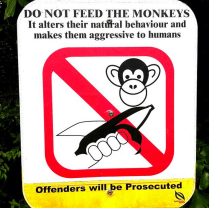
It is against the law in Singapore to feed the monkeys. The fine can be up to S$50,000 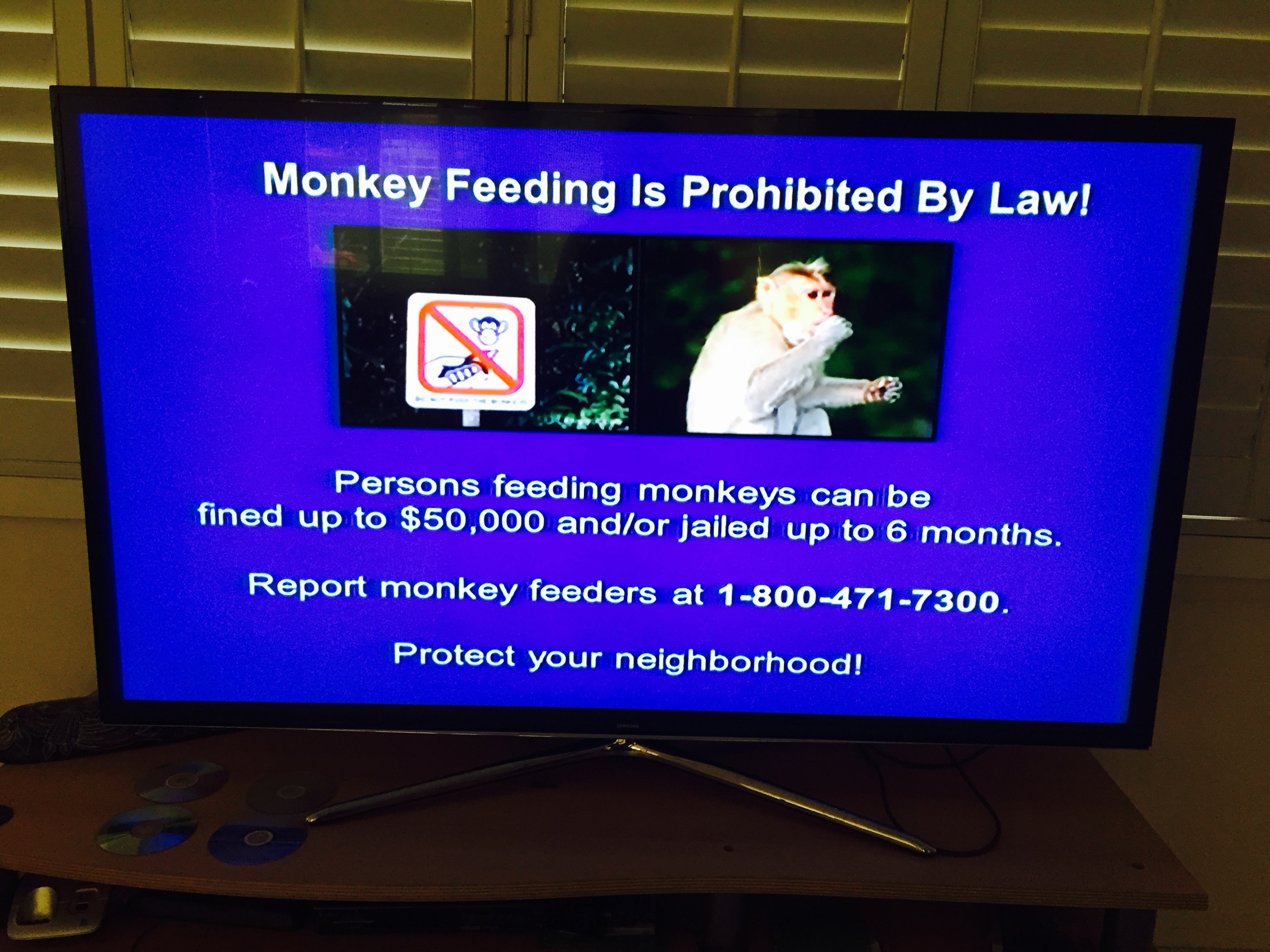 and/or jailed up to 6 months. And it is very dangerous as the monkeys will starting seeking food from people and can become aggressive instead of foraging for food in their natural habitat.
We must remember lo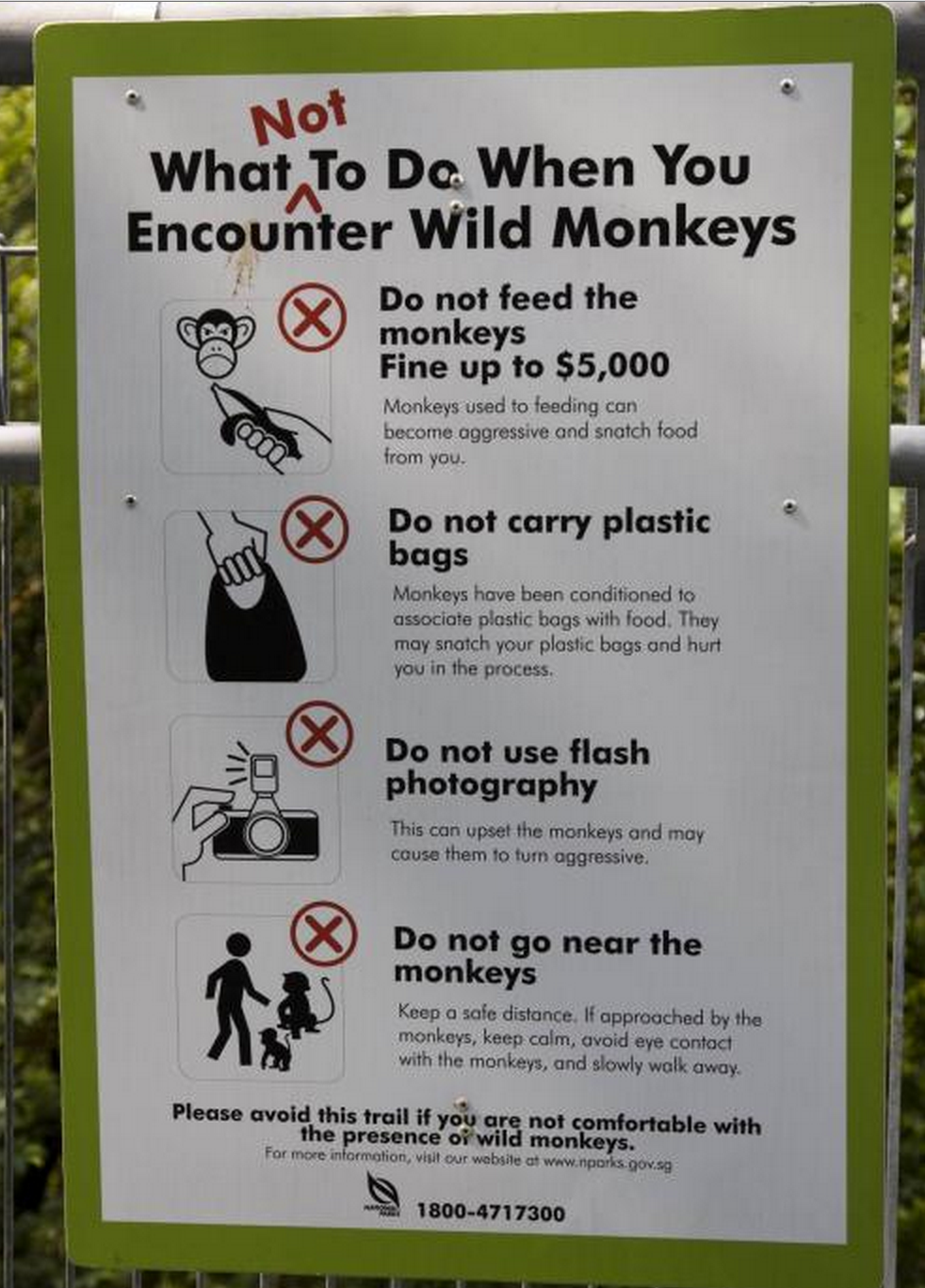 ng-tailed macaques are wild life, even though they have human like characteristics.
Always observe from a distance and…….
NEVER FEED THE MONKEYS!
Below are some interesting articles for more information. (Please excuse that they are not in the correct MLA format)
Works Cited
“Long-tailed Macaque (Macaca Fascicularis) at the Shores of Singapore.” Long-tailed Macaque (Macaca Fascicularis) at the Shores of Singapore. N.p., n.d. Web. 29 June 2015. <http://www.wildsingapore.com/wildfacts/vertebrates/mammals/fascicularis.htm>
“Monkey Complaints Fall by over Half after a Third of Them Culled,http://www.straitstimes.com/news/singapore/more-singapore-stories/story/monkey-complaints-fall-over-half-after-third-them-culled#sthash.u57HvTIu.dpuf.” The Sunday Times. The Straits SIngapore, 28 June 2015. Web. 29 June 2015.
“Monkey Musings: Respecting Singapore’s Long-tailed Macaque.” My Green Space. N.p., Mar. 2011. Web. 29 June 2015. <https%3A%2F%2Fmygreenspace.nparks.gov.sg%2Flong-tailed-macaque%2F>.
“Monkey See, Monkey Do: 5 Monkey Hot Spots in Singapore.” – Singapore More Singapore Stories News & Top Stories. N.p., 29 June 2015. Web. 29 June 2015. <http://www.straitstimes.com/news/singapore/more-singapore-stories/story/monkey-see-monkey-do-5-monkey-hotspots-singapore-2014102>.
“Please Do Not Feed the Monkeys: On Wildsingapore.” Please Do Not Feed the Monkeys: On Wildsingapore. N.p., n.d. Web. 29 June 2015. <http://www.wildsingapore.com/places/monkey.htm>.
Don’t judge a fruit by its odor!
 The “King of Fruits” – Durian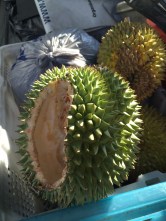
Visiting the wet markets of Singapore during the durian season was an interesting sensation for the nose. The spiny fruit has a very strong smell that is hard to explain. Some words that come to mind….rotting something, then sweet, then rotting something again. There is no comparison to any Western scent.
How do you know if a durian stand is nearby? Don’t worry your nose will tell you the durian stand is just around the corner well before you see it. That is why durian is not 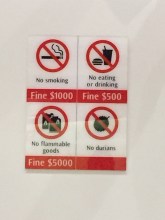 allowed on public transportation.
The durian fruit is native to Brunei, Indonesia and Malaysia and grows on a tree that can be up to 50 meters tall. Shorter trees are being propagated due to deaths from people getting hit on the head from the spiny dense fruit. That would be a horrible way to go, smelly and painful at the same time.
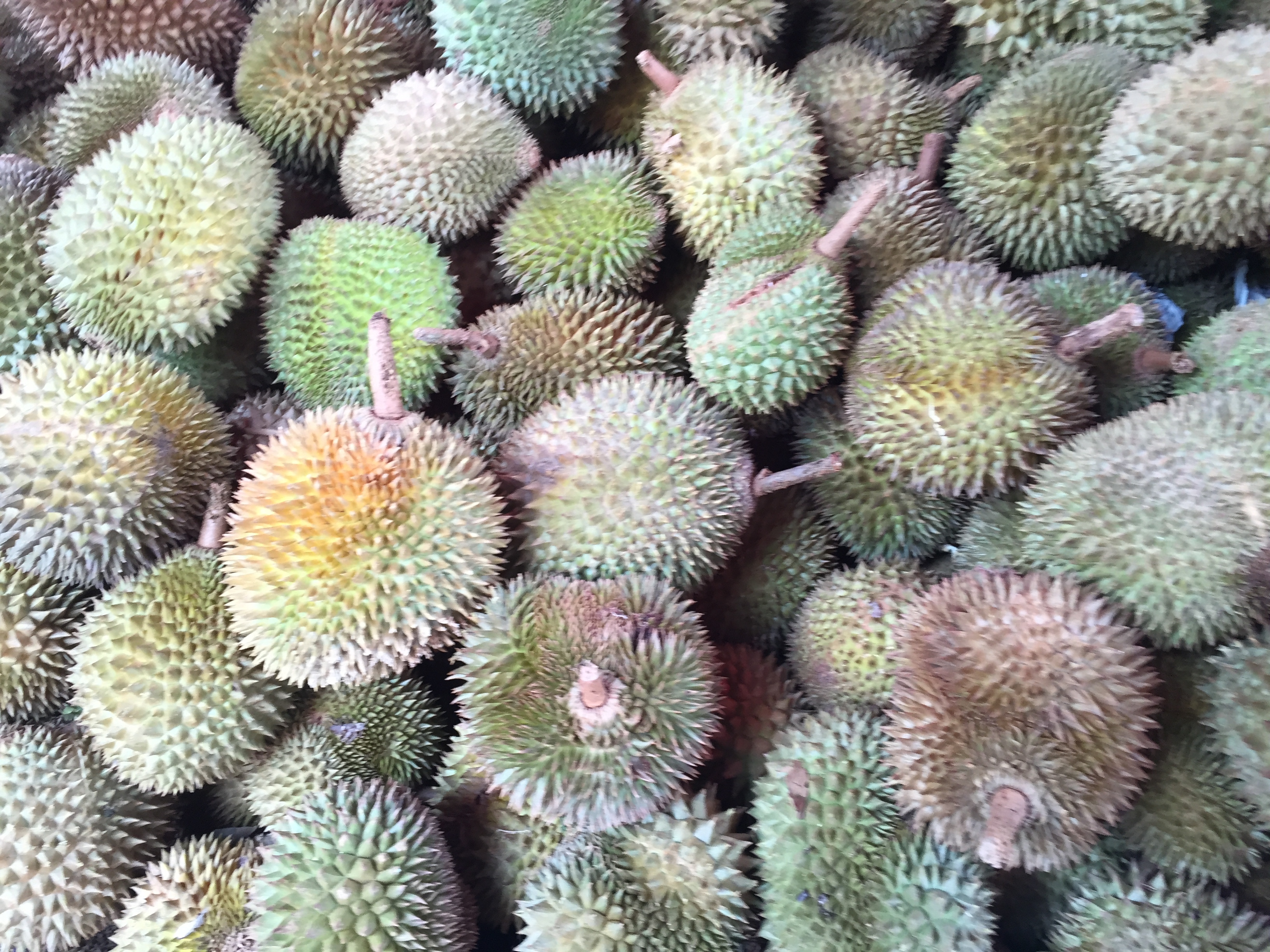 The durian season is June until August, the same as other tropical fruits like mangosteen, jackfruit and mango. Durian has a thick green thorny covered husk weighing one to four kilograms (1 kg equals about 2 lbs.). The husk must be removed to obtain the flesh or pulp which is made up of yellow-colored bulbs and is used in many sweet dishes in Southeast Asian cuisines. I was told durian popsicles are very good, but didn’t find them in our explorations.
The fruit has amazing health benefits. It is high in many vitamins and minerals, dietary fiber, and sadly also calories (a 1 kg durian is close to 1,500 calories). Due to the high sugar content eating durian will give you energy and contains no cholesterol, so more Americans should consider eating it.
My durian experience…It is an adventure that is hard to explain. The smell is indescribable; strong, nasty, rotten are a few words that come to mind. I did not have a problem getting the fruit past my nose as some people told me they had. The flavor? Well I didn’t think it had any; it was bland, not sweet, as I had expected. The durian is high in sugar content so it was a surprise to not taste sweet. Then there is the texture and that was the problem I had. The outside of the fruit had a thicker membrane, but the inside is soft and slimy, yet grainy in consistency.
I love trying different foods; the experience is extra special when shared with loved ones. Durian was too many different textures for my mouth to deal with at one time. So traveling the world tasting durian in the nine different countries in which is grows will not be added to my bucket list.
How to eat durian.
Step one: pose for the camera
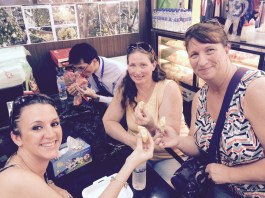
Step two: take a bite, but don’t eat the pit, only the soft flesh around it
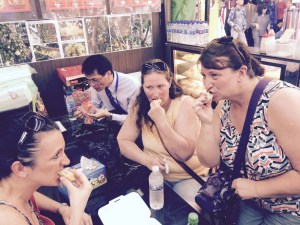
Step three: make weird faces
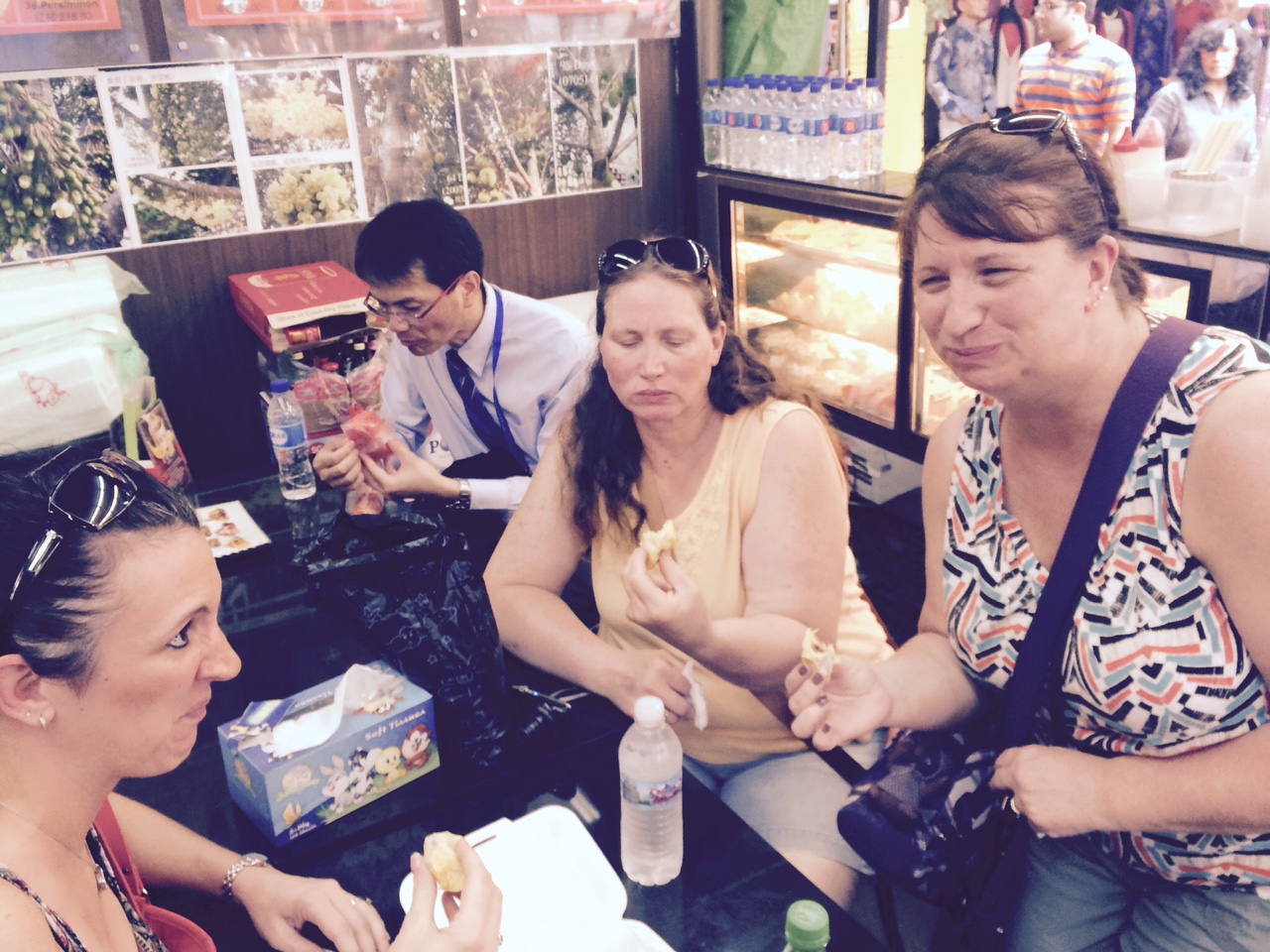
 Step four: take a drink to try to wash out the weird taste (hint: water does not get rid of the taste and for hours you will continue to hiccup (burp) the flavor
“Durian – The World’s Smelliest Fruit”
More information about durian:
http://www.yearofthedurian.com/p/first-durian-start-here.html#.VZjIju2qqko
http://thaifood.about.com/od/howtopreparethaifruit/ss/durianstepbystep.htm
Chinatown in Singapore
Chinatown is an English label, the Chinese name for the neighborhood is Niu Che Shui, and Kreta Ayer in Malay. The dominant dialect is Cantonese. Chinatown is a mix of souvenir shopping, shophouses, temples, museums and galleries, eateries, and well as a business district for day to day business.
Venders sell most things a traveler would be looking for; the typical coffee cups, hats and t-shirt souvenirs, to clothing, and many many items “Asian”.


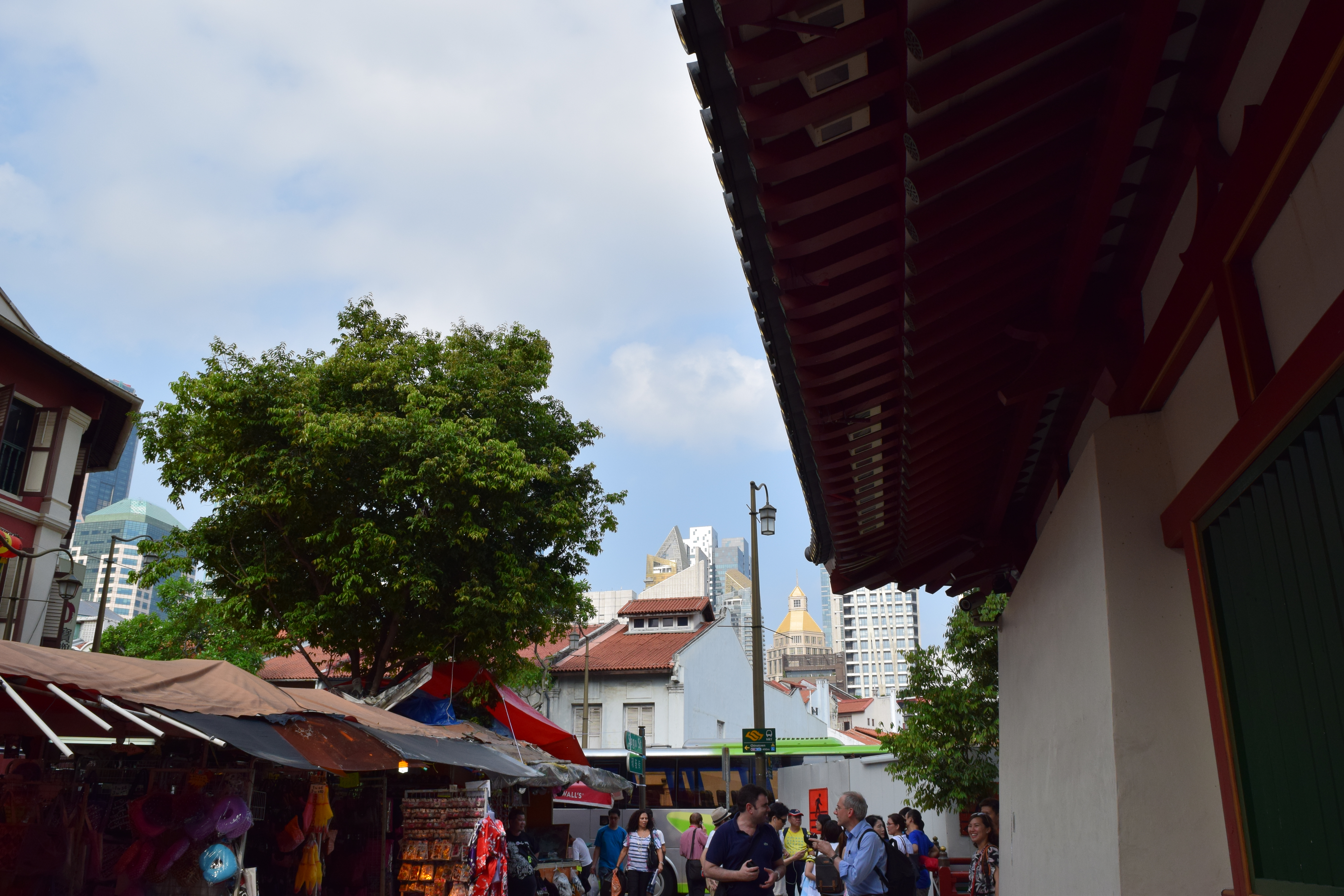
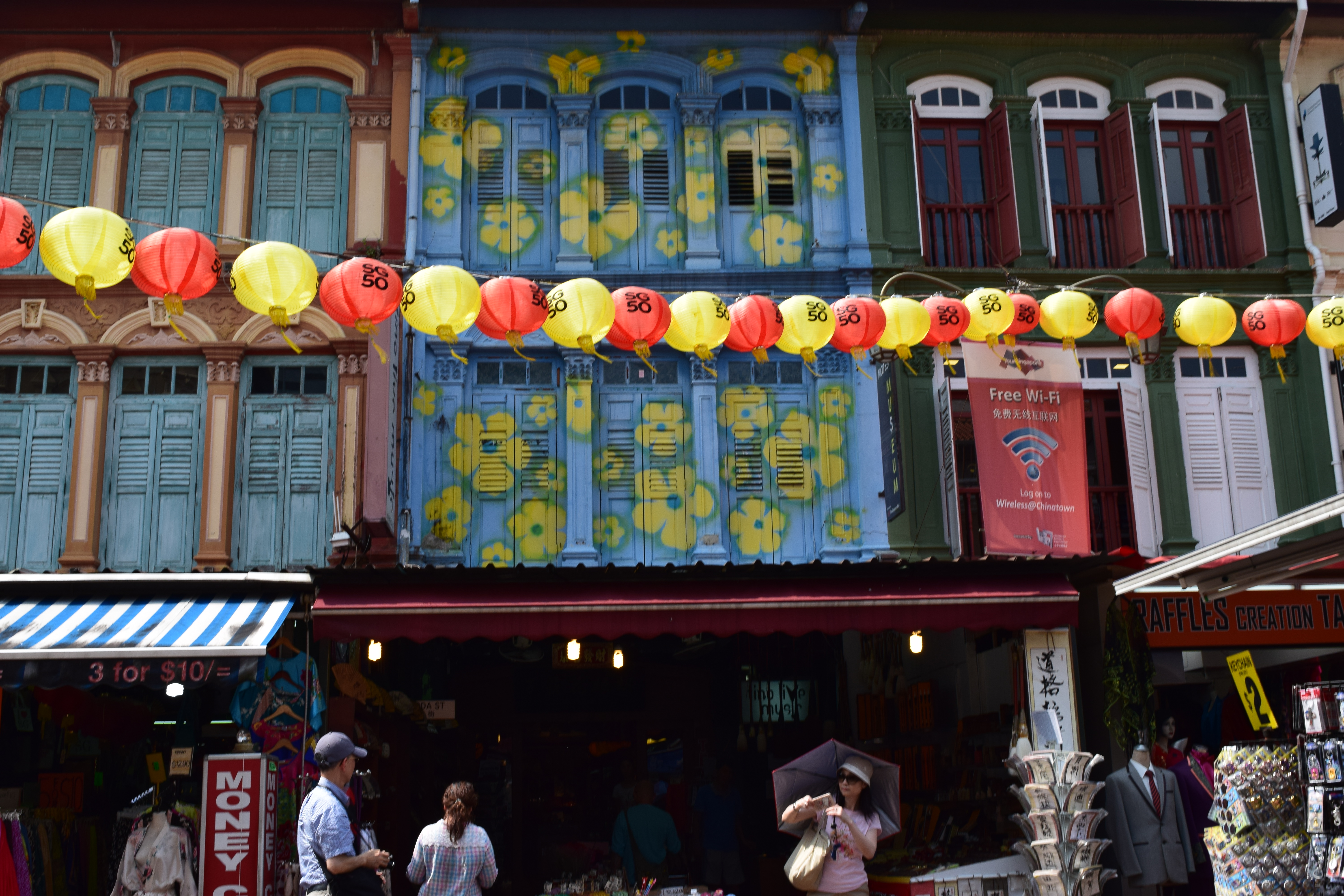
Buddha Tooth Relic Temple
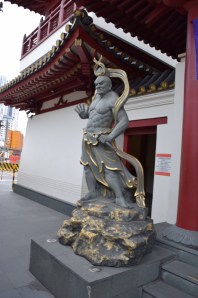
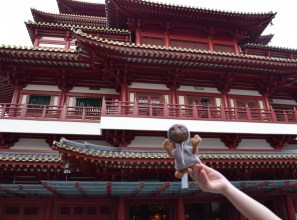
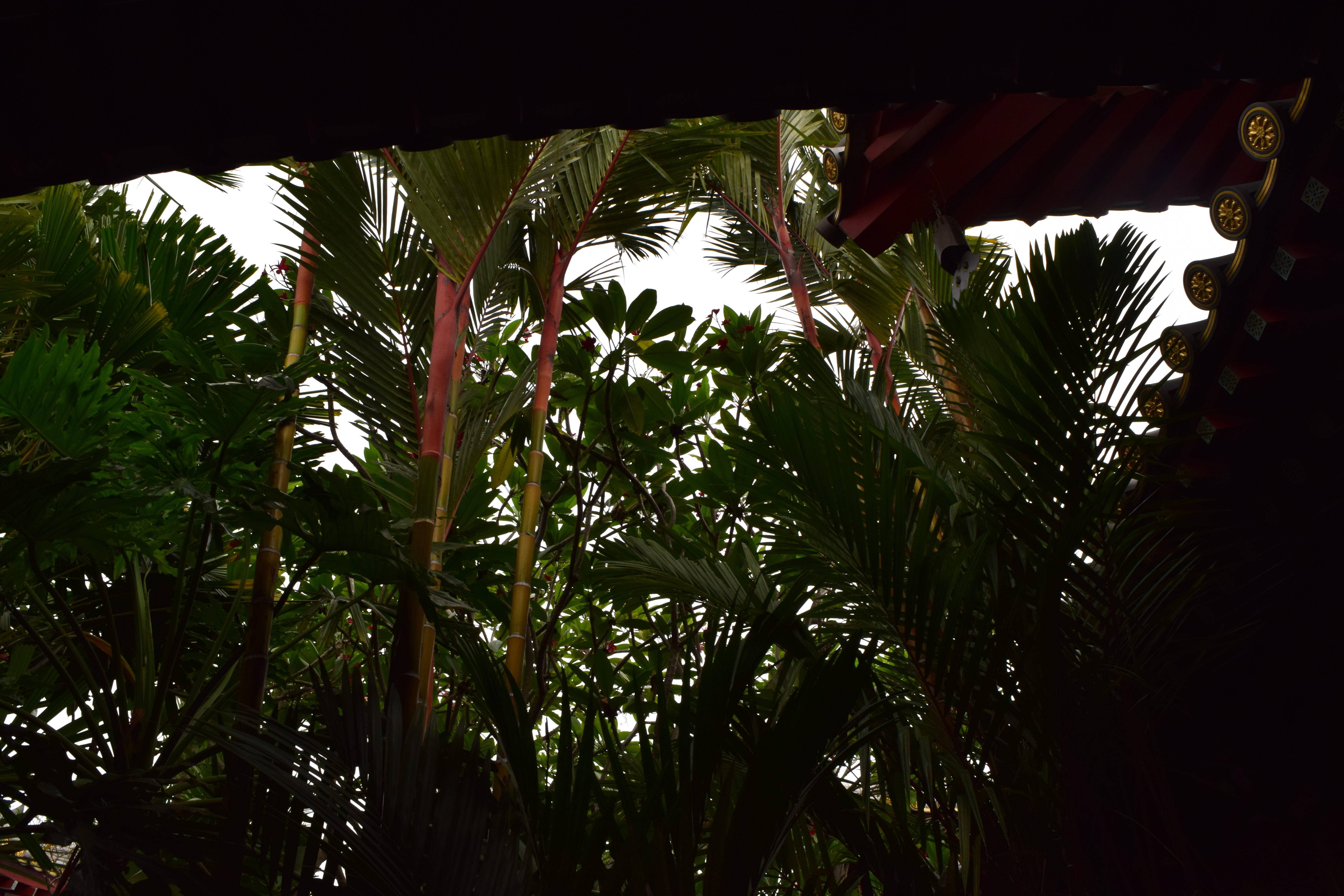
When traveling it is always an interesting cultural experience to walk through a temple to learn about the religion being practiced. The Buddha Tooth Relic Temple is adorned in gold statues and red velvet. It is not an old temple, it was completed in 1992, yet holds an very important relic, an eye tooth of Siddhārtha Gautama, Buddha. (There is no photography allowed inside the sacred room containing the tooth)
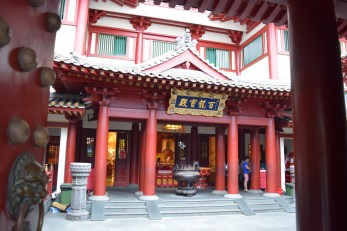

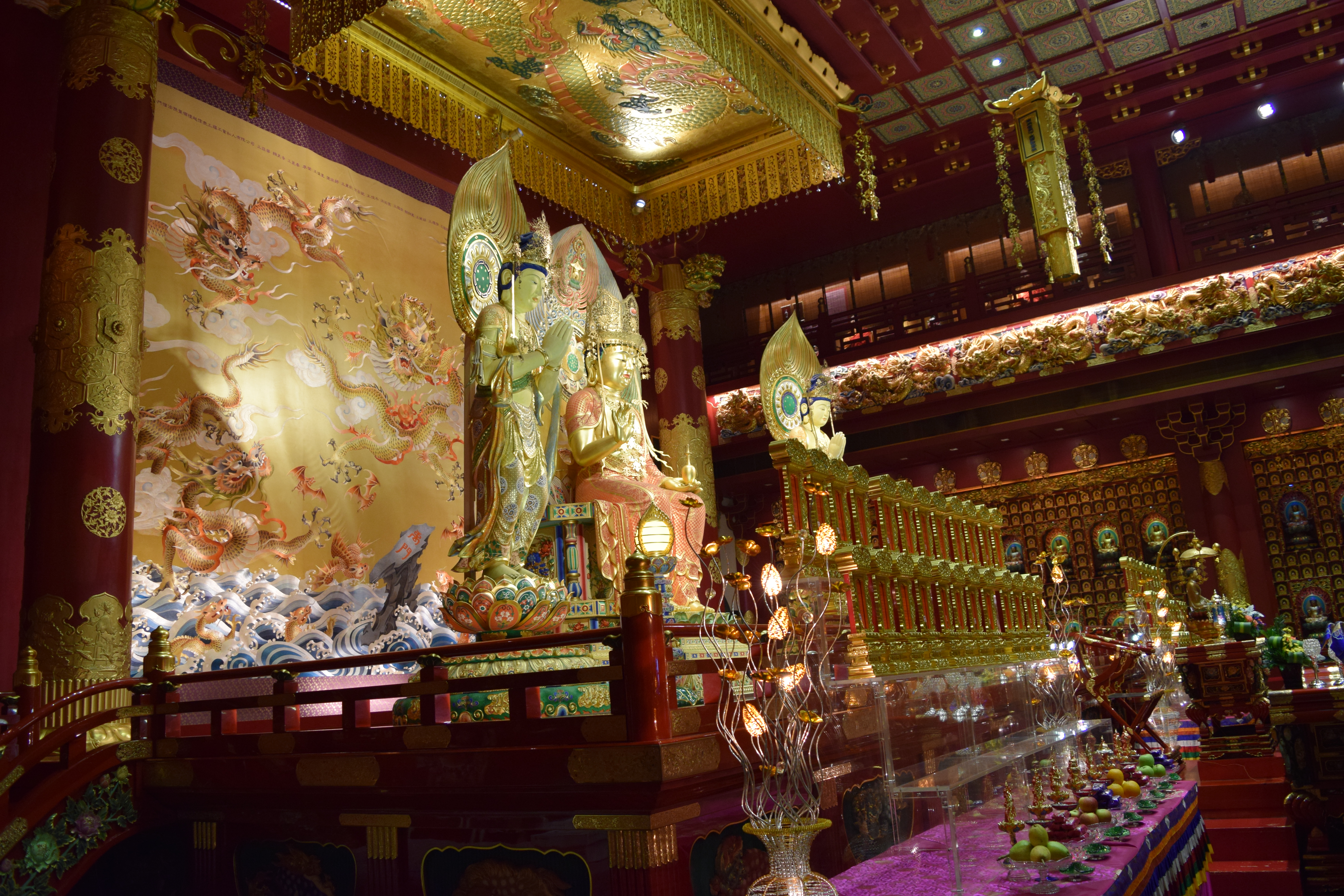
On the roof of the temple was a garden and the largest prayer wheel in the world.
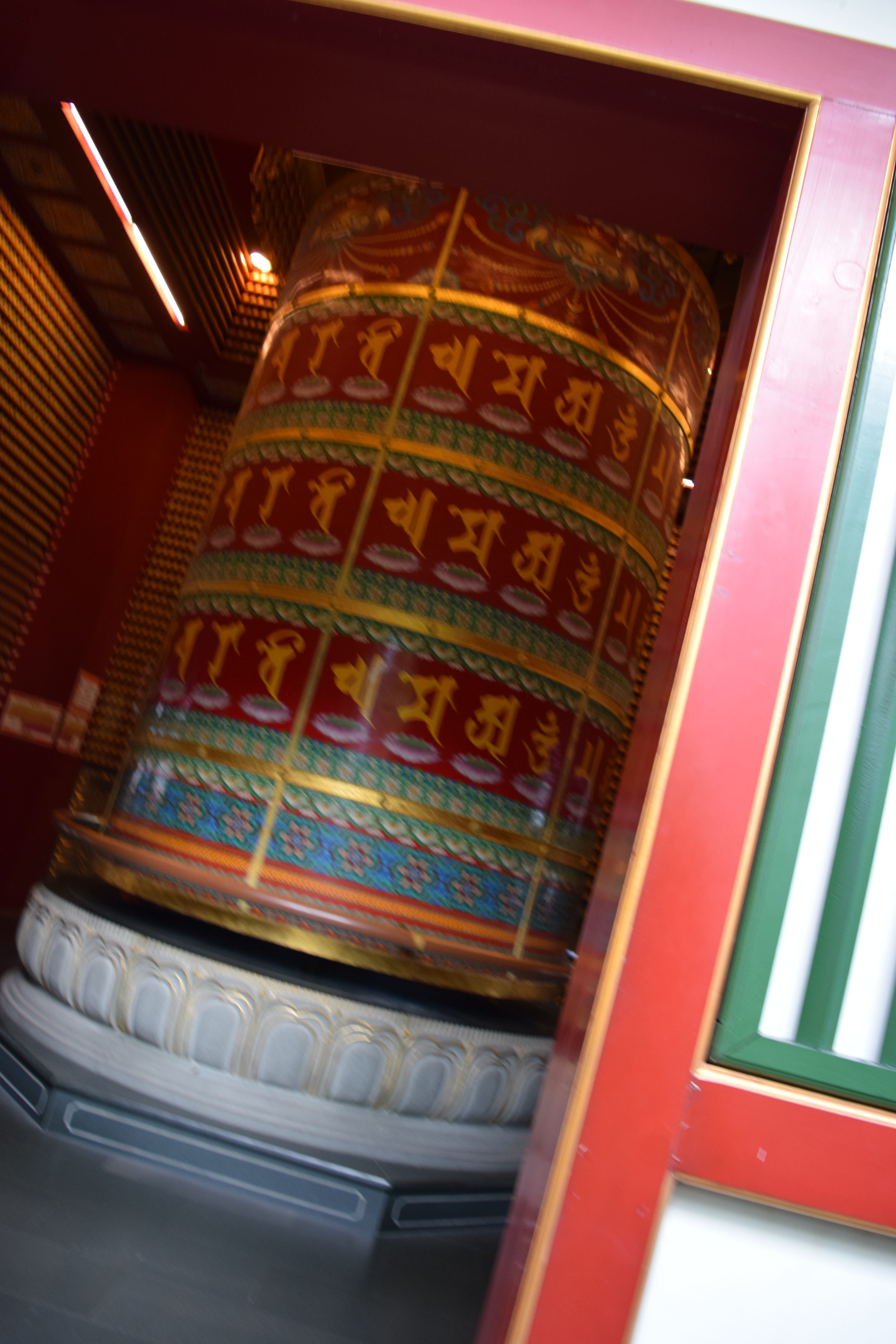


More information about the Buddha Tooth Relic Temple and Museum
http://www.btrts.org.sg/history-of-btrtm
Celebrating our nation’s independence!
Happy independence day!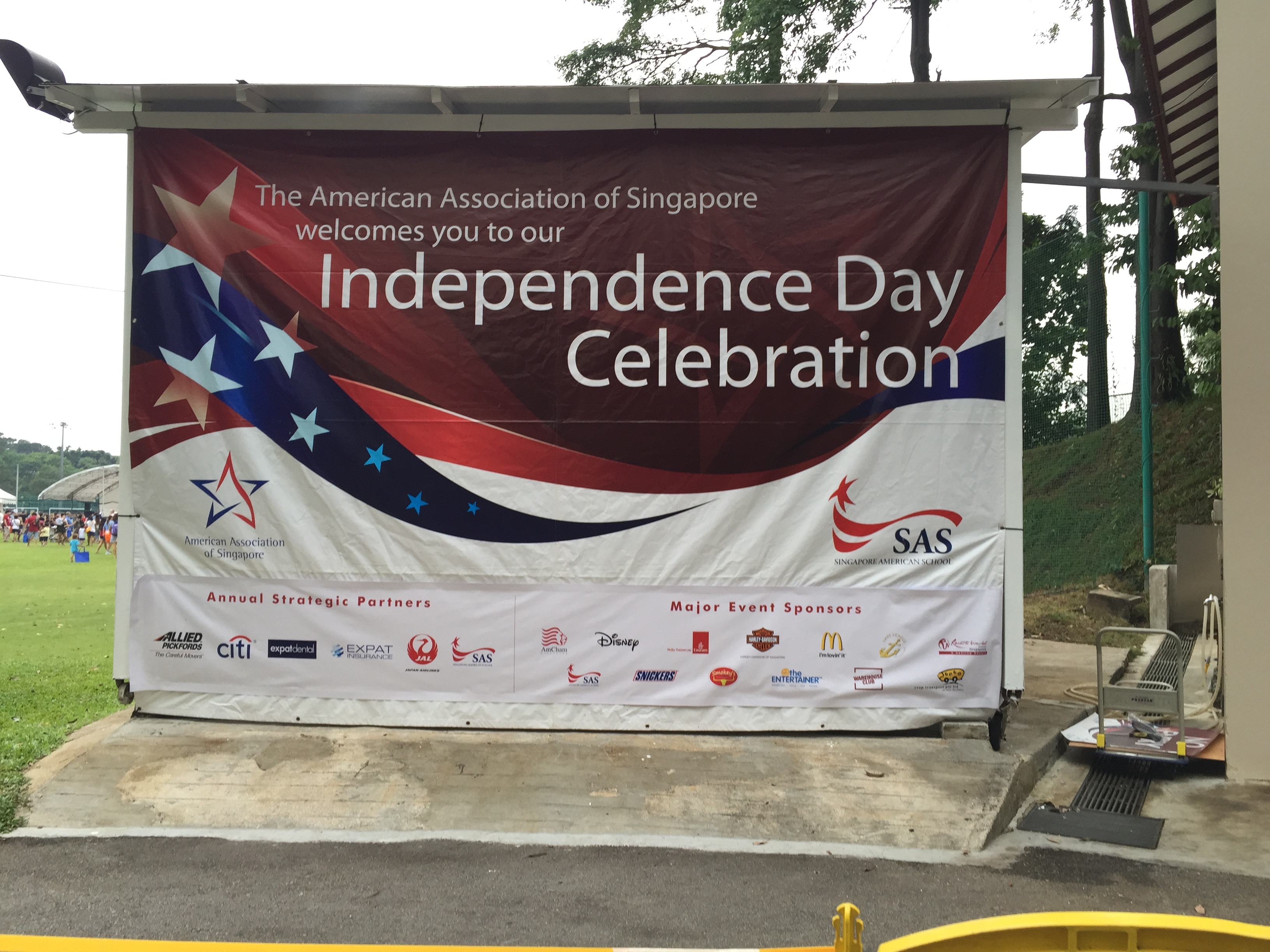
I was not planning to be in Singapore for the Independence Day holiday, but celebrating July 4th with the men and women of the U.S. military serving our country over seas truly is an honor. Everyone should spend Independence Day in a foreign country with members of our armed forces who have chosen (or been assigned) to serve outside of the United States. Patriotism is beyond strong. You can see the pride in each face, proud to be serving our country and celebrating the freedom guaranteed to us by our constitution and protected by our military.
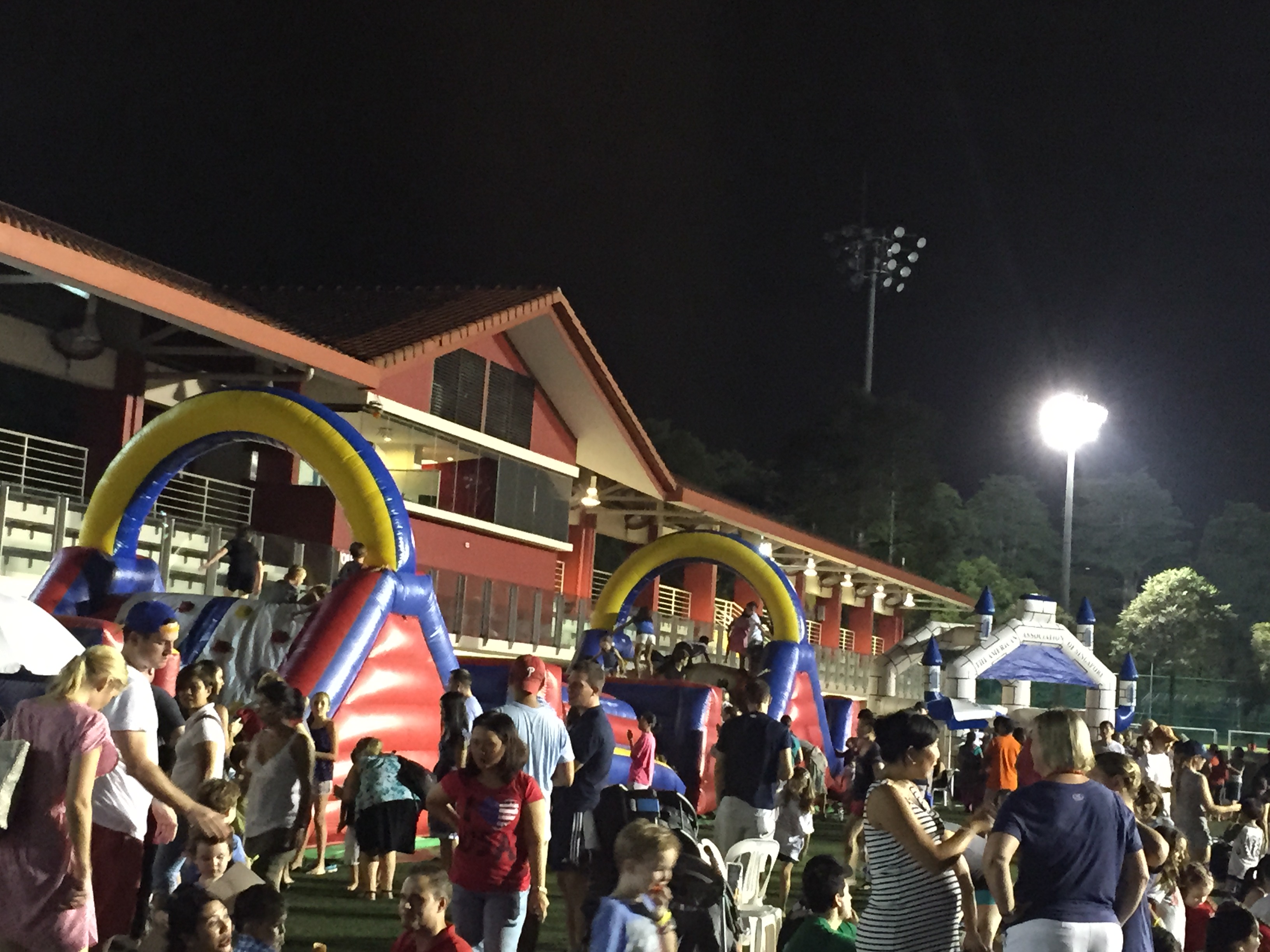
 We walk through security, a quick check inside our purses and backpacks, then inside to the food venders, carnival games, live music and bounce houses. Have we just entered a community celebration in the United States? No, we are on the playground of the American school in Singapore. An American style celebration….over stimulated children and adults enjoying their favorite beverages chatting with friends.

At dusk the party is interrupted to pay tribute to both countries that are part of the celebration. First the presentation of the flags, the singing of the Singapore national anthem, then the “Star Spangled Banner”,
 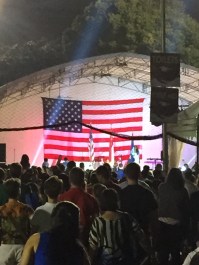 followed by cheers from the many people present; American military, expats (a person taking up residence in an other country), visitors (like me), and even some local citizens.
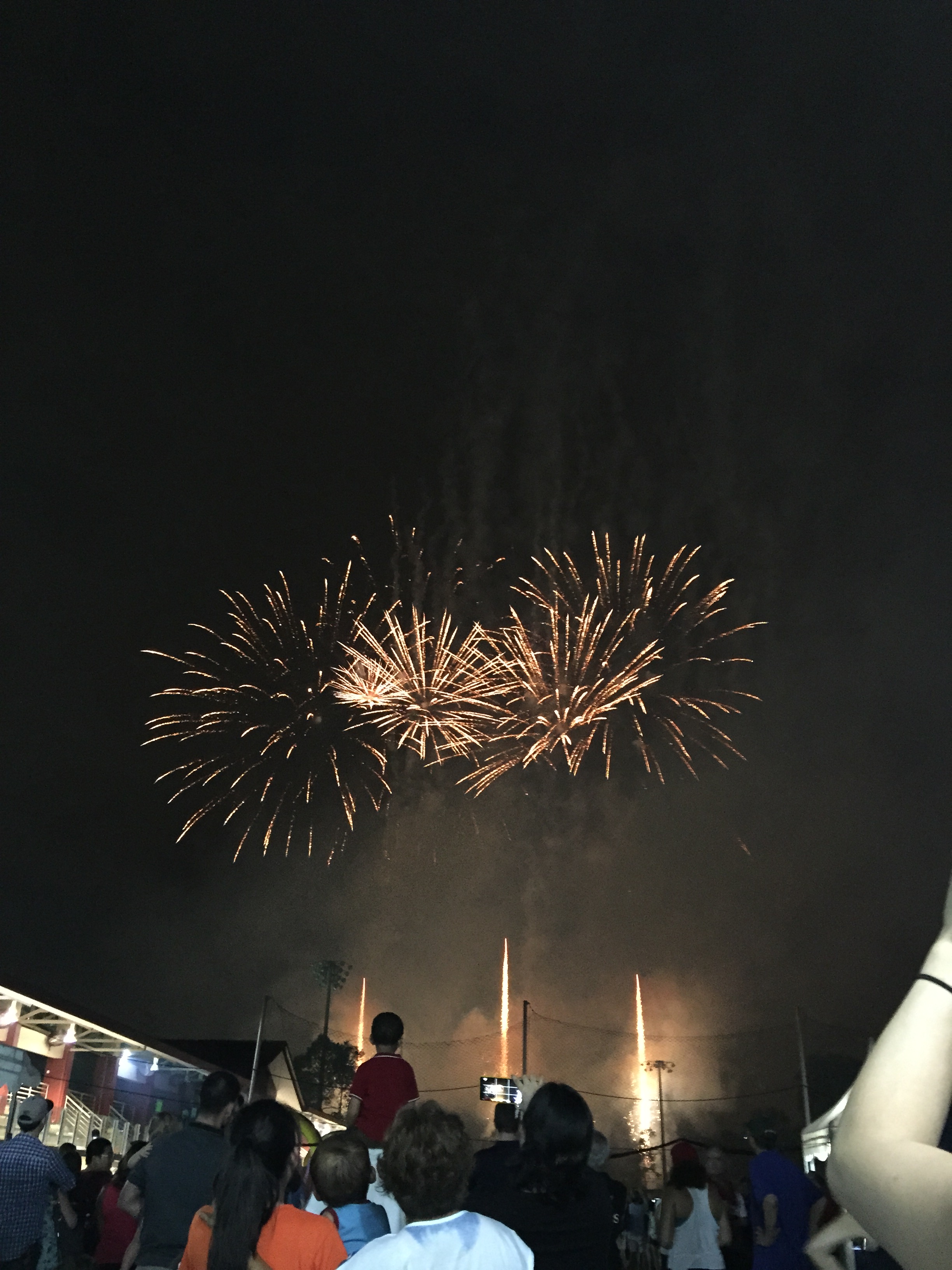
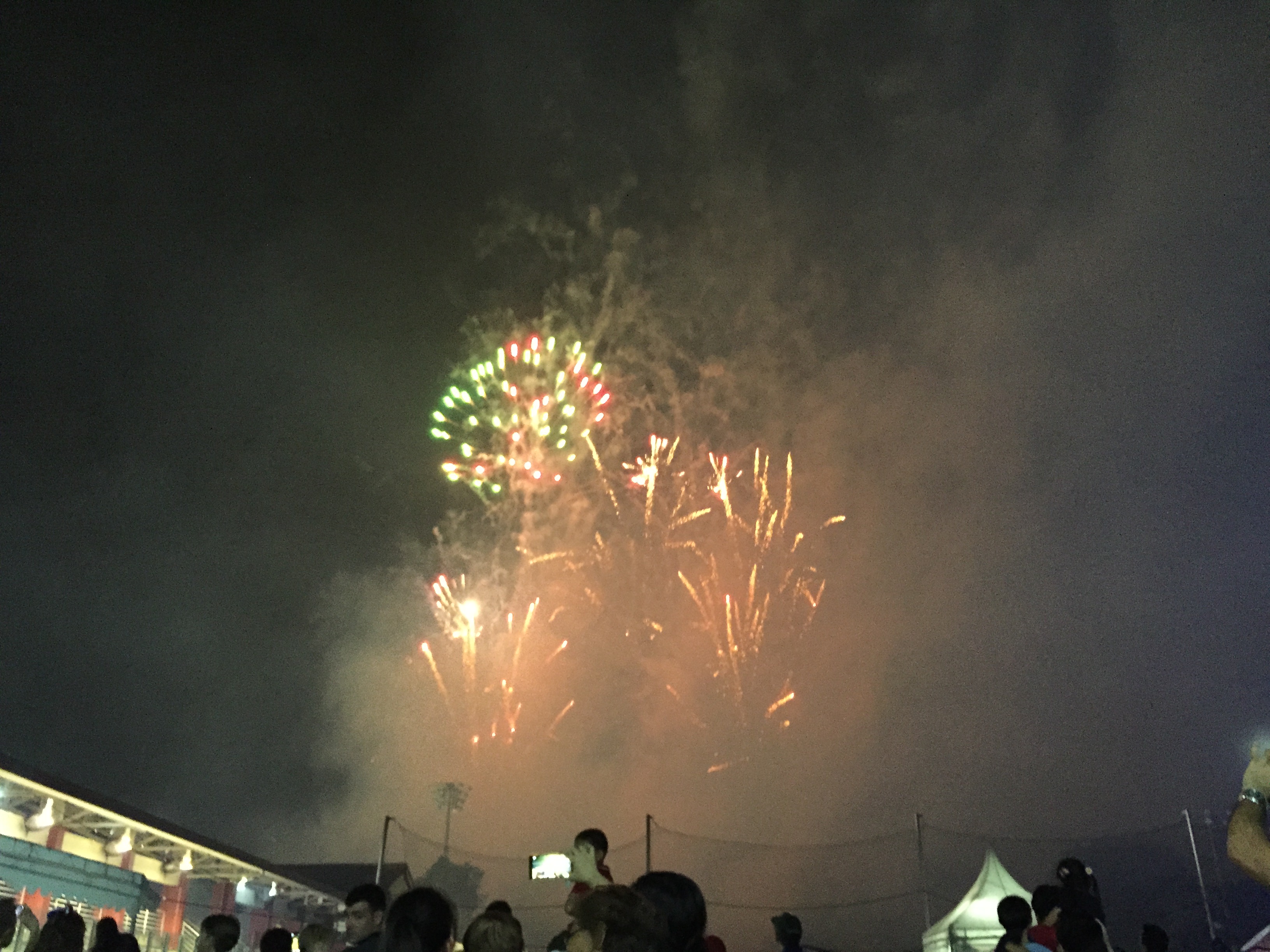
Then the crowd settles on blankets to watch the fireworks. One would have guessed you were in the United States celebrating in any city, small community, or neighborhood. The only difference….the gathering of people of many different nationalities, ethnicities, and religious beliefs.
Everyone gathered to enjoy the fireworks display, celebrate independence, and enjoy a gathering with friends. For a short time all those differences do not matter!




Day two of my Independence Day over seas experience.
The holiday celebration continued on Sunday, July 5th, with a backyard barbecue. Again over stimulated children, adults enjoying a few beverages, corn hole competition, a card game that lasts forever, and food. There are many different selections; wings, chips, dips, bacon wrapped chicken, brownies, red white and blue cupcakes and homemade Thai spring rolls, of course my favorite food at the party. The party guests were a mix of people from many different places; Canada, New Zealand, and different areas of the U.S. Some people were expats, others members of the U.S. military having lived all around the U.S., as well as having been deployed to many different countries before being stationed in Singapore. Wonderful people who made me feel welcome in their group, even though they knew in a short time I am back to the states and will probably never see any of them again. Truly an enjoyable evening of laughter, friendship, and celebration of our wonderful nation.
(Sorry no pictures of the barbecue as sharing a private party, children, and adults enjoying themselves would be an invasion of privacy)
Mowing the grass Singaporean style!
Rain shower is usually daily and thunder storms are often. (However it did not rain for the first two weeks I was here, and I have yet to see a thunder storm.) As a result of Singapore being 1 degree north of the equator (137 kg or 85 miles north of the equator) and frequent rain the vegetation is very green and tropical. So mowing the grass is a full time job but not with a lawn mower as I do with my grass as home. The men, bundled in clothing for protection from the flying objects and the hot sun, use weed eaters not lawn mowers. It is really quite efficient. No large trailer to haul the machines, easy to get in small spaces (which most grassy areas are small spaces), and they seem to do a good job.


An interest fact about Singapore is that there is no unemployment and no homeless people on the street. Everyone has a job. That job might be picking up trays and trash at a hawker stall or mowing with a weed eater the meridians between the streets, but everyone has a job. There is also government assistance to pay for housing for people with low paying jobs. As a result a clean city, no one living on the street, and everyone contributing to benefit the country.
An interesting model for other countries like the United States to follow.
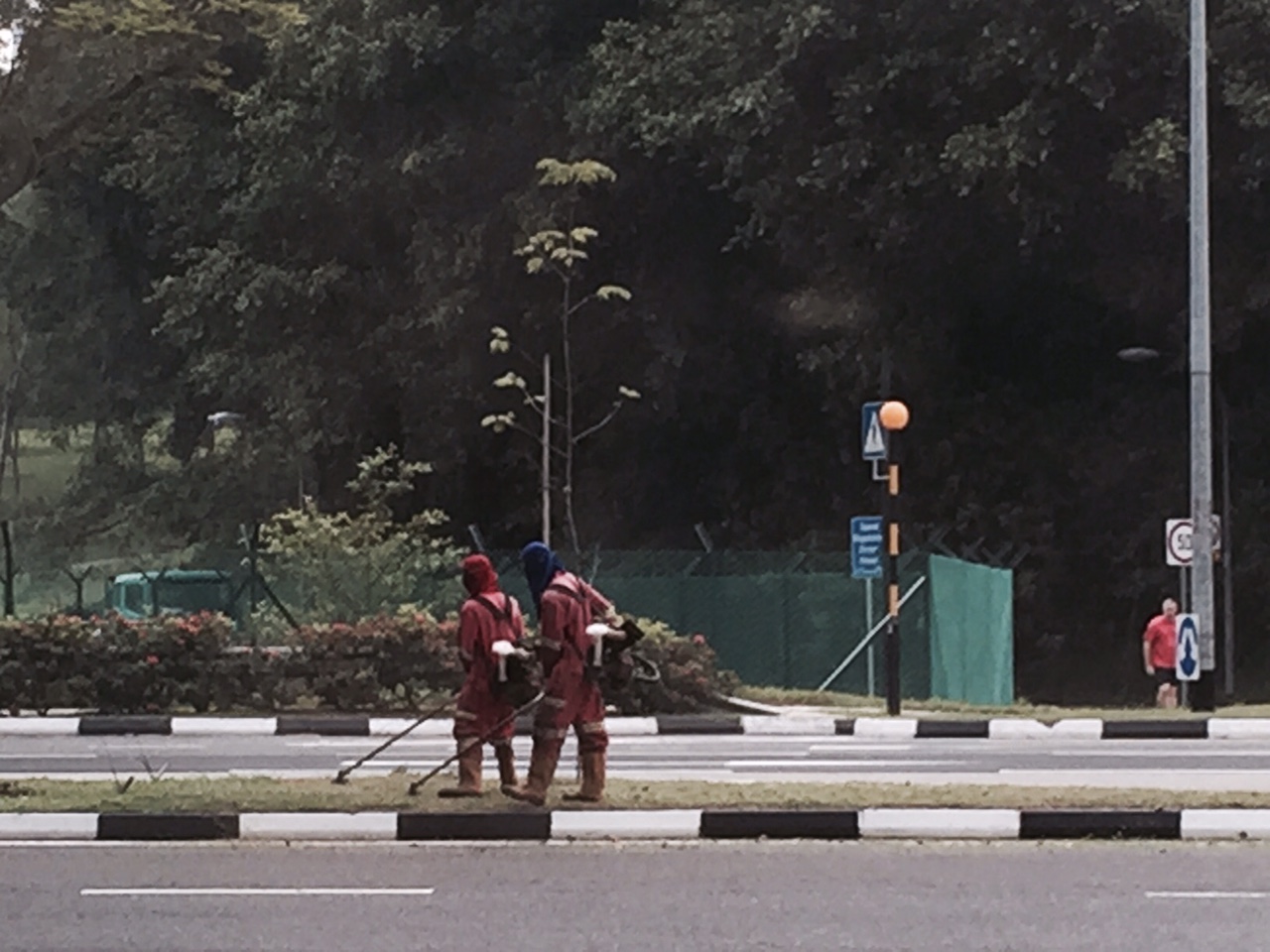
Mowing meridian between four lanes of traffic
Would you eat Pitahaya?
Pitahaya? What is pitahaya? A piece of clothing to keep the sun off? A type of bread eaten with mutton curry? A fruit originating in Mexico?
If you said a fruit from Mexico you are correct. Pitahaya, or dragon fruit, originated from Mexico then was transplanted to Central America, East Asia, South Asia, and Southeast Asia. The Pitaya Cacti blooms during the night and the flower wilts in the morning heat. The flower is pollinated by nocturnal animals and insects, such as bats or moths. The flowers have a very strong scent. It takes 30 to 50 days for the pollinated flower to become the dragon fruit. The cacti can produce fruit as many as six times a year. There are three different species of dragon fruit: white inside, purple/pink inside, or yellow skinned.
The dragon fruit is low in calories and high in nutritional value, containing many vitamins, minerals, and antioxidants. Some of the health benefits include lowering blood sugar and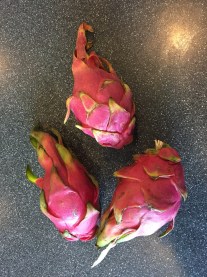 blood pressure, building strong bones and teeth, improve the immune system, and protect against cancer and heart disease (just to name some of the health benefits).
What does it taste like? Yummy. A mix of kiwi and pear. The seeds have no flavor and can be eaten.
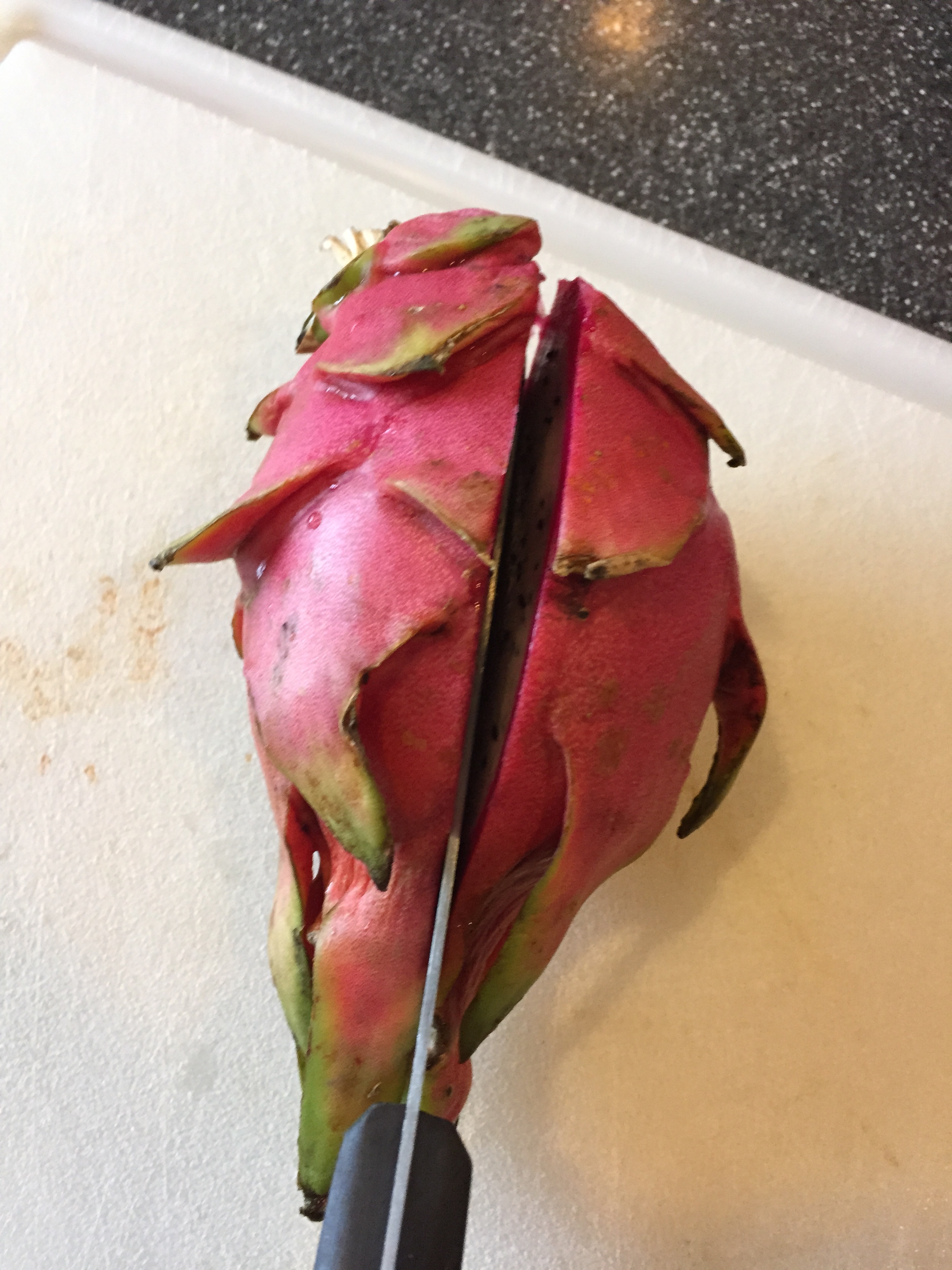
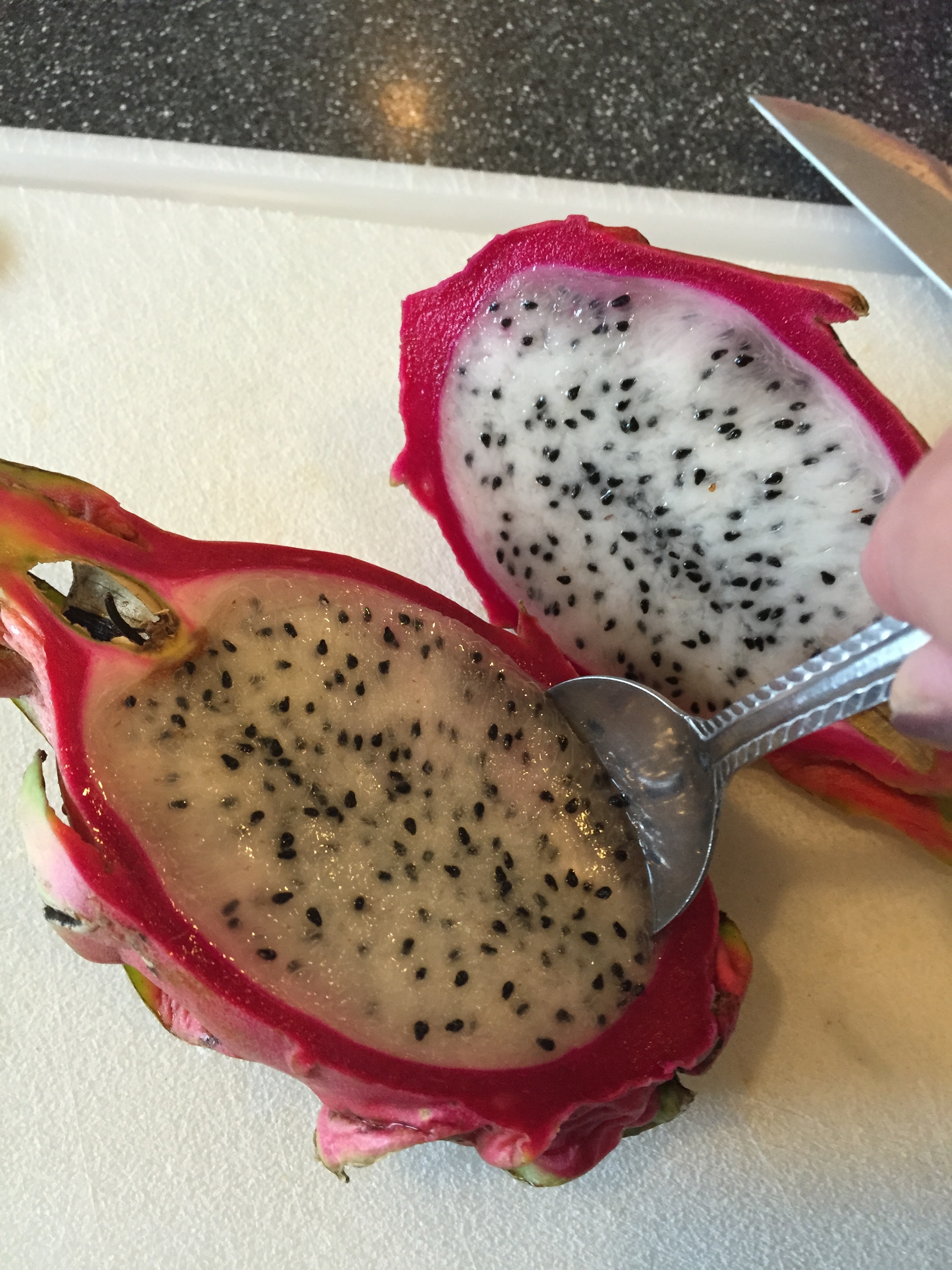
How do I prepare the fruit to eat? Do I eat the skin or peel it? What can you do when you don’t know how to eat something? Look it up on You Tube! Someone there will tell you.
First cut the fruit in half with a sharp knife

Next scoop out the inside with a spoon
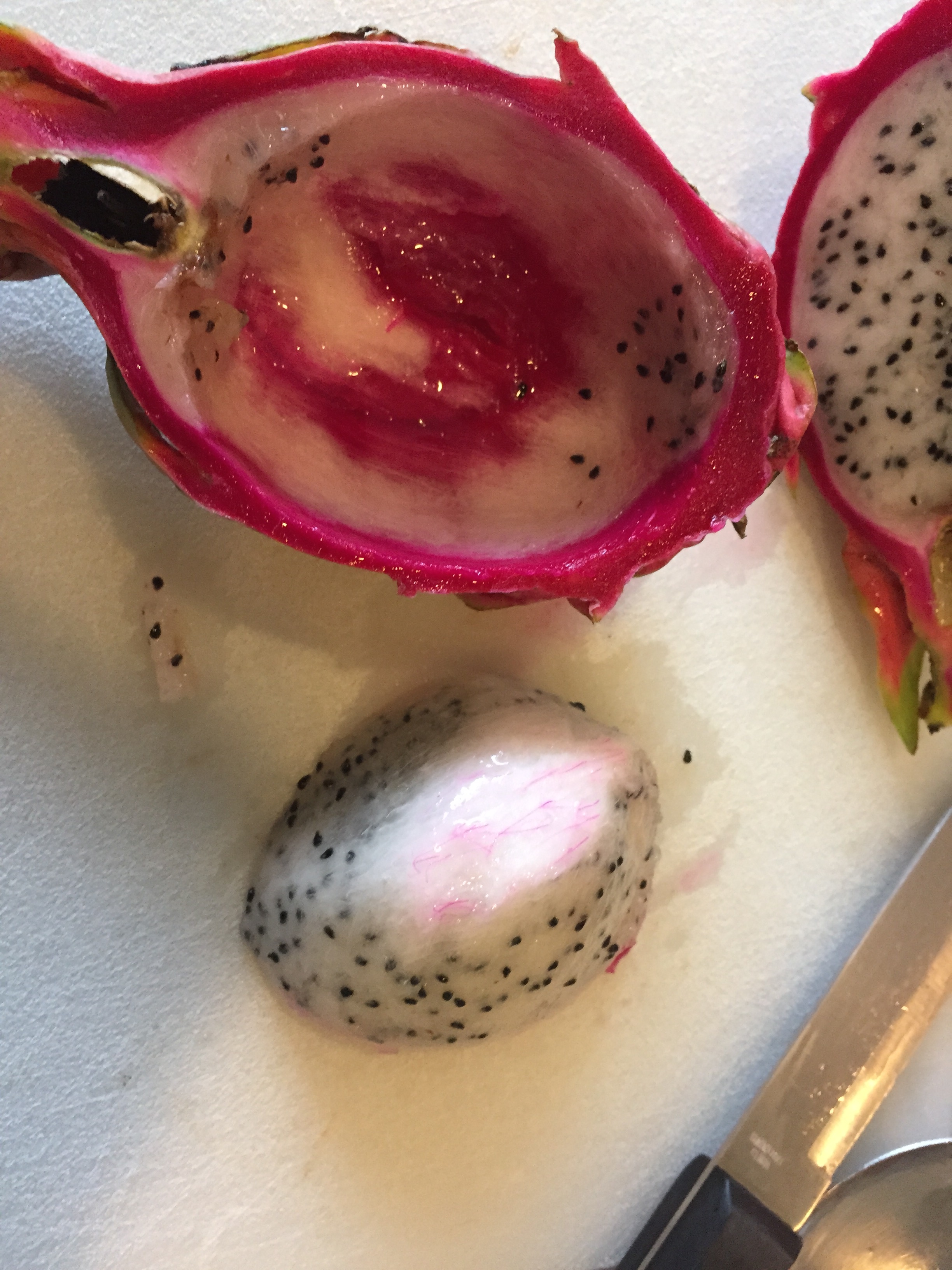
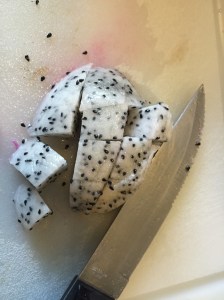
Finally cut the dragon fruit into pieces and enjoy.
When is Dragon Fruit ripe?
 Roaming the World with Mrs. Kelly