
My travel to South Korea is a research trip focusing on the development of South Korea and the country it is today. The trip is sponsored by the Korean War Legacy Foundation and the Ministry of Patriots and Veterans Affairs, Republic of Korea. This program is part of the Korean War Digital History Project. The expectations of the trip are to read materials focusing on the Korean history, participate in webinars, interview a Korean War Veteran of Korean Defense Force Veteran and create teaching materials about culture, history or the Korean War.
A brief history of Korea
Korea has a rich history that spans 5000 years. The peninsula had connections to China until it eventually was divided into three kingdoms:
- Silla – 57 BCE through 935 CE
- Paekche (Baekje) – 18 BCE through 663 CE
- Kogoryu (Goguryeo) – 37 BCE through 668 CE
The three kingdoms were unified under the Silla Kingdom from 668 CE through 938 CE. Three dynasties controlled the Korean peninsula until foreign dominance took over the peninsula. The Unified Silla Dynasty lasted until 938 CE. The western name for the county, “Korea”, came from the Koryo Dynasty in power from 917 CE to 1392 CE. The Chosen (Joseon) Dynasty was in power from 1392 CE until 1910 CE when Japan took control of the peninsula. The Chosen Dynasty greatly impact cultural practices and established Confucianism to govern the country.
Korea was invaded by the Japanese in 1592. With the help of China fought off the invasion, only to be invaded by the Manchus in 1627. The Manchus then conquered China in 1644 allowing the Chosen Dynasty to regain control of the country. During the middle 19th-century, European powers were taking control of the land in East and Southeast Asia. Korea continued to maintain seclusion and became nicknamed the “Hermit Kingdom”.
The United States sent Admiral John Rogers to Korea to open the country to trade in 1871. By 1854, through military force led by Commodore Matthew Perry, the U.S. had forced Japan to open its ports for trade. The U.S. hoped to do the same in Korea. Admiral Rogers also was to find out what happened to the U.S. merchant ship, General Sherman. The ship was attacked and crew killed while traveling up the Taedong River (leads to modern day Pyongyang).
What has become known as the “first” Korean War, the U.S. shipped was fired upon as it entered the Gangwa Straits on its way to the Han River with a goal to reach Hanyang (present-day Seoul). Admiral Rogers demanded an apology. After it was not received, ten days later the 1,230 U.S. Marines and sailors attached the Choji Garrison on the island of Gangwa-do. After one day of fighting the U.S. lost three soldiers and the Koreans lost two-hundred forty men. The Koreans call this attack the “Shinmiyangyo,” which means “Western Disturbance in the Shinmi Year.”
The results of the American attack at Gangwa-do resulted in a treaty being signed between Korea and the U.S. in 1882 to establish relations between the two countries. King Gojong would help Korea maintain independence from China. Fifteen Marines and sailors were awarded the Medal of Honor for fighting on foreign soil.
The Korean peninsula was invaded by the Japanese and become under colonial rule from 1910 CE to 1945 CE. The Japanese controlled with harsh rule trying to wipe out the Korean culture. At the end of World War II, the peninsula was divided between the United States and the Soviet Union at the 38th Parallel and controlled by each country from 1945 through 1948. This was to be a temporary division that is maintained today.
The Democratic People’s Republic of Korea (North Korea) and the Republic of Kores (South Korea) were formed in 1948. The Korean War was fought from 1950 through 1953, with an armistice signed on June 27, 1953. This armistice is in effect today with no formal peace agreement signed, resulting in the Demilitarized Zone and the Joint Security Area at the 38th parallel established.
Resources
“Korean History and Political Geography.” Asia Society,
asiasociety.org/education/korean-history-and-political-geography.
“TWE Remembers: The Korean Expedition of 1871 and the Battle of Ganghwa
(Shinmiyangyo).” Council on Foreign Relations, Council on Foreign Relations,
http://www.cfr.org/blog/twe-remembers-korean-expedition-1871-and-battle-ganghwa-
shinmiyangyo.
“A Timeline of Korean History | Asia for Educators | Columbia University.” The
Commune System (1950s) | Asia for Educators | Columbia University,
afe.easia.columbia.edu/timelines/korea_timeline.htm.
Day one: June 23, 2018
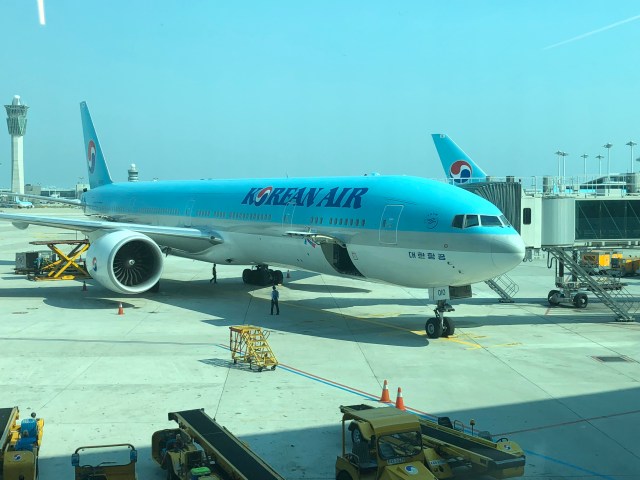
I am ready to depart for the Republic of Korea. It will be a long 13-hour flight. I was lucky to be seated in the first row. I will enjoy a little extra leg room but looking at the “Prestige Class” sign the entire flight makes me so envious of the travelers who are enjoying the first class. ET will be traveling with me. The airline provided each passenger with a pillow, a soft blanket, a bottle of water, and a packet containing slippers, headphones, and a toothbrush.


Our Korean lunch was very tasty. But sad to say I did not get much sleep. Playing with my phone and camera was a great way to pass the time. ET found himself on top of the world with the help of “Snapchat” tricks I learned from students on the Germany trip in June.


Day two: July 24
Arrival in a foreign country can be hectic. You must go through immigration, then collect baggage and finally meet your group. But arrival at Incheon Airport was very low stress. Immigration was no big deal, quickly moved through this part of the airport. My bag arrived with no problem. I always worry about my bag getting lost or delayed. Then finding my group was extremely easy as many travelers had already arrived and were waiting outside the baggage area for our group to arrive.
After everyone arrived, we boarded the bus to travel to our home away from home at the Dragon City Hotel in Seoul. As you can see from the map we will travel some distance to reach Seoul and our hotel. There is a subway that travels from Seoul to the airport. After the long flight, it was nice to relax on the bus and see a little of the Republic of Korea.


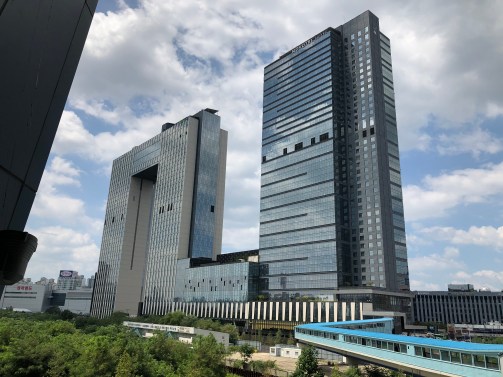
The rooms at Dragon City Hotel are amazing and very comfortable. We each have our own room. It is nice to have a little privacy at the end of a long day. We are in the center tower. Each tower is a different hotel with a shared lobby.


I would like to write a little about the toilets. Toilets are a funny thing to include in a blog post, but they are amazing. The seats are heated and the control panel includes a bidet. What does that mean? When the button is pressed the toilet squirts water to clean your backside. To an American unfamiliar with a bidet, it sounds odd but is actually quite nice.
The view from my hotel window was an amazing Seoul skyline.

Day two: July 25
Our first full day in the Republic of Korea has a very full itinerary. We start the day by traveling to the Demilitarized Zone (DMZ) / Joint Security Area (JSA). Then we tour Imjingak before returning to Seoul. In Seoul, we visit the National Cemetary and the War Memorial. In the evening we watch a Korean Pansori Theater: “Shimcheong” at the Korea House and end the day with a wonderful dinner.
The DMZ, located at the 38th parallel, is considered the most heavily militarized area in the world. The zone is 4 kilometers wide and 248 kilometers in length and divides the People’s Republic of Korea (North Korea) and the Republic of Korea (South Korea). This zone was established as part of the cease-fire signed by military leaders on July 27, 1953. A peace treaty has never been agreed upon by the government of either country.


The pictures above show the signed armistice agreement, plaques show every nation who fought during the Korean War as part of the United Nations forces, the map of the location of the DMZ and a red line indicates the location of the “Northern Limit” line in the Yellow Sea. This line indicates the farthest north South Korea can send ships. It was explained by the Australian soldier who was doing the orientation that North Korea believes this line is too close to the country.


The “Axe Murder” incident occurred on August 18th, 1976. Two U.S. Army officers were killed with axes by North Korean soldiers as a popular tree was being cut down within the DMZ. The North Koreans claimed the tree had been planted by Kim Il Sung, leader of North Korea. The UN forces felt the tree was blocking the view in the DMZ. Three days later “Operation Paul Bunyan” took place where the tree was removed. DEFCON-II (Defense Readiness Condition) was issued putting combat fighters and aircraft carriers were deployed. The incident resulted in increased tension but did not result in warfare. Kim Il Sung did send a message to the Joint Security Command with regrets the incident occurred. The monument shows the location of the poplar tree.
Panmunjom (Truce Village) is the location of meetings between leaders of North Korea, South Korea, and United Nations forces. These are the famous blue buildings sandwiched between buildings belonging to North Korea and South Korea. Tours are allowed on both sides of the village. North Korea only allows visitors from Russia and China. While we were in the village there were visitors at the top level of the North Korean building. The cement line between the buildings marks the dividing line between the North and South. It also marks where the leaders of both countries held hands while stepping over the line to symbolize working toward peace.
The inside of the middle blue building is the location where leaders meet. The table in the middle of the room shows the division of Panmunjon. It is divided down the center by microphones that record all activity in the building 24 hours a day.


Our tour stopped at Guard Tower #3. The soldier guiding our tour pointed out the North Korean village of Kijŏng-dong located within the DMZ. The North calls it “Peace Village” while the South refers to it as “Propaganda Village”. The buildings are made of solid blocks with the windows and doors painted on. Light shines from the top of the building down toward the ground at night, but the windows do not light up. That is why it is believed the building is solid blocks.
South Korea also has a village in the DMZ. Daeseong-dong is a farming village with many living restrictions. To live in this village you must have lived there before the Korean War or be a descendant of someone that lived there. Only one bus is allowed into the village one time a day. The residents are required to be in the house at sunset. To visit the village you must apply for clearance two weeks in advance. The government also allows retired soldiers that have served at the DMZ to live there. Our bus passed the village, but we were not allowed to take pictures.
We visited a tourist area within the DMZ that gave us more views of the border and telescopes to look into North Korea. The diarama showed the location of key places within the DMZ. We also had a view of the Kaesong Industrial Region where a factory was built by South Korea but located in North Korea. Products made here are shipped to South Korea to be sold. There is one highway that goes in the region. At one time a train also went into the region but is no longer used.
Lunch today was cafeteria style. Everything was very tasty. There were large jars of ginseng which Korea is known for the high quality. There were also statues from the XXIII Winter Olympic Games in Pyeongyang. They became a great photo opportunity for all the American teachers.


We visited Imjingak is a park located on the Imjin River in the city of Paju, South Korea. It is located 7 kilometers from the DMZ and was built in 1972 with the hope for reunification one day. The parklike setting contains an observation deck, restaurant, many monuments in honor of the war, amusement park, and a train that once went between the two countries. The Mangbaedan Alter is near Imjingak. Families separated in North and South Korea can face the north and perform ancestral rights.
Our next stop was the Seoul National Cemetary where 165,000 martyrs, soldiers, police officers, reserve forces, and key figures of the provisional government. The Memorial Tower contains the memorial tablets of 104,000 soldiers who died during the Korean War but their bodies were never found. There are also 7,000 unknown soldiers whose bodies were found but were never identified. Memorial Day on June 6th is celebrated to honor the brave patriots who died for their country. We were honored to participate in a wreath ceremony placed in front of the Memorial Tower.
The afternoon journey ended at the War Memorial of Korea, located at Yongsan-gu, Seoul. We each placed a mum at the base of the monument listing the soldiers who died from our state. There were memorials for all 50 states, as well as all the other countries fought under United Nations forces. The museum also displays artifacts from the war, including weapons, wax figures of key leaders, tanks, airplanes, and vehicles, including the limousine of King Il-sung that was confiscated by the South Korean military.
After a short break and time to clean up a bit from our day in the humid climate, we enjoyed a traditional Pansori theater performance “Simcheong”. The story is a melodrama about a young girl who sells herself to sailors to be a sacrifice to the sea. She believes her father will have his eyesight restored because of her sacrifice. Simcheong is reincarnated to become the beautiful bride of the king. Her father regains his eyesight and is reunited with his reincarnated daughter. The theater performance included beautiful music performed with traditional instruments and included light technology to create the effects of the sea. Audience participation was also part of the theater performance.


Day two came to a close with traditional Korean food and a rice wine that looked like milk.


Day three: June 26
Today we begin our exploration at Gyeongbokgung Palace, which means “palace greatly blessed by heaven”, in Seoul then known as Hanyang. The palace was built in 1395 by King Taejo, just three years after the Joseon Dynasty was founded. The location of the palace follows the Neo-Confucian beliefs with Namsan Mountain and Cheonggyecheon Stream in the front and Bugaksan Mountain at the back. To follow the “mandate of heaven” stars circle heaven and mountains are stars. So the palace is built in front of Bugaksan Mountain to follow the celestial plan of building the palace in a sacred space.


The palace was destroyed by fire during the Imjin War with Japan in 1592, a brief truce in 1596, and another invasion 1597. Japan withdrew forces in 1598 due to a stalemate. Japan’s goal was to conquer the Korean Peninsula ruled by the Joseon dynasty and China ruled by the Ming dynasty. Prince Regent Heungseaon restored the palace in 1867. The palace was again destroyed by the Japanese during their occupation from 1910 to 1945. The Government-General Building, the Japanese colonial headquarters, was built in the location of the palace.
Restoration of Gyeongbokgung Palace started in 1990 and continues today. The Japanese building was torn down in 1995. The palace buildings, including the main gate, have been restored to their former glory.
As we visited the Gyeongbokgung we ran into teenagers dressed in “hanbok”. These are traditional Korean clothing. It is common for people to dress in hanbok and then go out in public. One advantage of dressing in traditional clothes is to get free admission to attractions and discounts at restaurants. The group we saw were actually American students on a trip learning about Korean culture and practicing their Korean language skills.
We also viewed a changing of the guard ceremony at Gwanghwamun Gate at the entrance of the palace grounds. There are no royalty living in the palace today, so the ceremony is only a formality to show tourists the formal procedure that once took place.


Our next adventure was a little shopping at Insa-dong and a visit to K-Style Hub cultural center. Insa-dong is in the center of Seoul consisting of the main street with alleys branching off. Galleries, traditional restaurants, tea house, and souvenir shopping line each side of the street. At the K-Style Hub, there are areas to learn about Korean food, culture, medical advice, and fun things like taking a picture with K-Pop stars in a photo booth. At the medical advice exhibit, they did a skin analysis and then suggested what type of procedures you needed to solve your skin issues.


Lunch today was traditional Shabu Shabu consisting of a large pot of broth in the center of the table for meat and vegetables to be added. Then the meat is eaten with a rice ball and a leave of lettuce all rolled together. It was an amazing meal and one of my favorite.


We spent a little time in the after lunch at the National Museum of Korea learning about the many “national treasures” on exhibit. The museum displays artifacts that date back to the Paleolithic period through the Joseon dynasty. I really like to see the many faces of Buddha when I visited Asian countries, so many of my pictures are of statues depicting Buddha.
At the museum gift shop, I added my Buddha statue collection. When I travel to a country where Buddhism is practiced I purchase a statue to add to my growing collection. Remember anything I purchase must fit in my suitcase and my checked bag must weigh less than 50 pounds. So my Buddha purchase is always a small statue. At home, my Buddhas are displayed on shelves near my kitchen sink. This also provides the opportunity to enjoy them while I am in the kitchen.


While at the National Museum we met with Korean teachers to learn about how the Korean War is taught in their schools. Three teachers from the United States group spoke about their Korea War units. Then three teachers from the Republic of Korea explained their activities.
Seoul Digitech High School used technology for students to create projects relating to the Korean War. A group of students created a “virtual reality” video game allowing gamers to actually fight in battles. Another group of students interviewed Korean War Veterans and then produced a book about explaining the story of the war. The music students worked jointly with a U.S. Army band conductor to learn music pieces and perform them with his direction.
Su-Won High School students research the Korean War monuments located along the eight roads around Su-Won. They interviewed Veterans and survivors to write journal articles about their experiences. The students also host a ceremony at their school to celebrate alumni who fought in the war. The school also has a monument celebrating the war heroes. They also write acrostic poems about the Korean War.
An all-girls high school focuses on the Japanese occupation of Korea, the Korean War, and democratization. One of their most interesting projects completed by history club students was to pay for a memorial to honor the “comfort women” who were raped by Japanese soldiers during their occupation of Korea. The statue is located across the street from the Japanese embassy in Seoul. The Japanese government has never apologized for the mistreatment of these women. Every Wednesday protests are held by Korean citizens outside of the embassy demanding the Japanese government issue a formal apology.
We went to see the “Memorial to the Comfort Women”. It was very moving to see a statue honoring the women who suffered under Japanese occupation. It is amazing the impact students can make when they work together for change.


During our open discussion time, one of the Korean teachers spoke of how the United States played a role in the colonization of Korea by the Japanese. He wondered how we felt about his statement and do we teach about the influences of the United States. He also spoke of the importance of understanding the current peace discussions between North and South Korea to work toward reunification. He believes it is important for everyone to know that the Korean peninsula currently does not have peace. He also suggested it would be helpful for us to teach about Korea today and then work backward through their history to create understanding.
Add pictures
It is always interesting to learn how history is taught in other countries. I enjoyed hearing the Korean teacher’s views about the United States involvement in his county being occupied by Japan. As teachers, we would have no idea how other people feel about our country unless we have amazing experiences such as this teacher forum between Korean and American teachers.
We ended our day having dinner with the Korean teachers. It was very enjoyable to be able to talk more informally with the teachers.
Day 4: July 27th
Today is “Armistice Day”. This is the date, July 27, 1953, that cease-fire agreement was made between the United Nations, South Korea, North Korea, and China. We must remember this is not a “peace” agreement. To this day a peace agreement has not been signed. That is what current talks are about with North Korea, South Korea, and the United States.
The “Armistice Agreement” was made between military leaders, not government officials. The Korean peninsula today remains divided at the 38th parallel due to this agreement and created the Demilitarized Zone that exists today.
The first event we attended today was the “Korean War Armistice Agreement Commemoration Ceremony”. This ceremony celebrated all United Nations forces that participated in the Korean War. There were soldiers in attendance from around the world. Sixteen countries deployed combat units to fight together as the United Nation Forces: United States, United Kingdom, Canada, Turkey, Australia, Phillippines, Thailand, Netherlands, Columbia, Greece, New Zealand, Ethiopia, Belgium, France, South Africa, and Luxembourg. There were six more countries who provided medical support units: India, Norway, Denmark, Sweden, Italy, and Germany.
The ceremony was attended by Veterans, family members, and many dignitaries. Lee Nak-Yeon, Prime Minister of the Republic of Korea, awarded medals to Veterans. It was amazing to see him walk through the auditorium shaking Veteran’s hands. Gen. Vincent K. Brooks, current Commander of the UN Combined U.S. Forces Korea, also spoke to the audience. Another speaker during the ceremony was Navy Admiral Harry Harris, U.S. Ambassador to Korea. There were also music selections performed by children’s choirs, a taekwondo demonstration, and a play performed by two children helping us all remember the legacy the Veterans sacrifices and heroism.
After the ceremony, we met with staff from the Academy of Korean Studies. A presentation was given about research that was completed comparing what information is in textbooks about Korea and the Korean War. Their research shows that educational instruction needs to implement more Korean history. I agree with their presentation. The textbooks I use have very little information. It is my goal to create a better understanding of Korean history.


Our afternoon excursion took us to Digitech High School in Seoul. We heard a teacher share the work of the students on projects relating to the Korean War. Visiting their school allowed us to see first had their work. We listened to the Korean War Veteran who worked with the students. He was very interesting. He had two very strong messages to share with us: Korea “needs the U.S. for a Korean alliance to occur to prevent a second Korean War” and “freedom in the peninsula is in your (U.S.) hands”. Both statements made me really think about current negotiations and the importance of the United States remaining involved in these talks.
We were then given time to see the students work. They were so proud of sharing their projects. They gave us a copy of the book they published. We also had a chance to play the virtual reality video games the students created. I played a game where I needed to kill zombies who were going to attack me. This was my first time wearing virtual reality goggles. It was an amazing experience to play the game created by high school students. The other game had the gamer fighting in battles of the Korean War while wearing virtual reality goggles. What an amazing activity for the students to learn about the war and create a video game at the same time.


We attended an evening banquet dinner with Korean War Veterans. Again the Prime Minister, Commander of UN Forces, and U.S. Ambassador spoke. Medals were awarded to soldiers or family members if the soldier has passed away. Pi Woo-Jin, Minister of the Ministry of Patriots and Veterans Affairs. This government office provided funding for the teacher program that provided us to travel to the Republic of Korea. It also provides services to Korean Veterans, like the U.S. Department of Veteran Affairs.
During dinner, there were three Republic of Korea soldiers and their commander at my table. I enjoyed chatting with the soldiers and learning about the mandatory military service. Each male must serve at least two years. One young man told me he went to college for two years first and now is serving his two years in the army. He plans to finish his degree in engineering after his military requirement is complete. I asked him if he had ever visited the DMZ. He told me “no, it is too scary there”. He was quite surprised that we visited this area and could not understand why I would want to go there.


Day 5: July 28
Temple Stay
Interesting articles related to the Korean peninsula:
Khan, Gulnaz. Korea’s Heavily Armed Border is Packed with Tourists. National Geographic.
 Roaming the World with Mrs. Kelly